It all began with the traditional Schwalenberg blue-printing technique and a question: How closely do I have to adhere to the traditional method?
For the exhibition “mitBLAU,” I explored regional blue-print motifs, old stencils, and a craft that preserves beauty, knowledge, and history. The longer I looked, however, the more I felt compelled to disrupt the familiar patterns.
What started as a single playing card eventually became an entire deck: MatriaSKAT. It’s about traditions in flux, nature, bees, and the opportunity to take a fresh look at even familiar rules.
The Starting Point: Blueprint
In blue printing, a color-repellent paste—known as “papp”—is applied to the fabric using printing blocks called “modeln.” These areas remain uncolored when the fabric is dipped in the indigo bath. This creates the characteristic white patterns on a blue background.
I was particularly interested in the plant forms, animals, and small scenes depicted in the traditional motifs. They tell the story of a region and of a craft that has been passed down through generations. At the same time, I saw the rigid guidelines, the closed structures, and the male-dominated world of the master workshops.
How closely do I have to stick to tradition?
Not every tradition has to be carried on unchanged. For my artistic exploration, I therefore wanted not only to preserve the old patterns, but also to transform them: to rotate, mirror, reassemble, and place them in a different context.
The first playing card is created
The idea for a playing card came to me quickly. It allowed me to turn things upside down in a very direct way. I adapted the traditional costumes to resemble bark beetles. The two beetle-like figures encounter tradition—and suddenly, nothing is quite the same as it was before.
The red-and-white border is reminiscent of the caution tape that was everywhere during the COVID-19 pandemic: exclusionary, confining, garish. That first card was still cold and unyielding. But it set something in motion.

But does a piece of indigo-printed fabric have to be blue?
The more I delved into the dark characters, the more they dampened my spirits. I wanted to pursue the idea of playing cards—but at some point, the blue-and-white contrast seemed too cold to me. For a playable Skat deck, I needed multiple colors anyway. So: more color, more lightness, and a new cast of characters.
The Good News: The Queen’s Queen
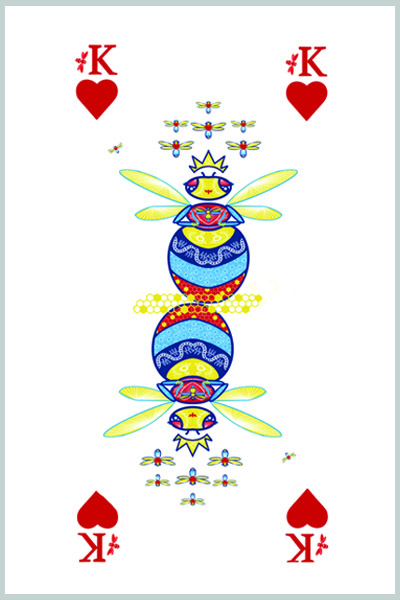
As I looked at the familiar card games, I immediately came across the next outdated hierarchy: Jack, Queen, King. Oh, come on, guys. It’s time for something new.
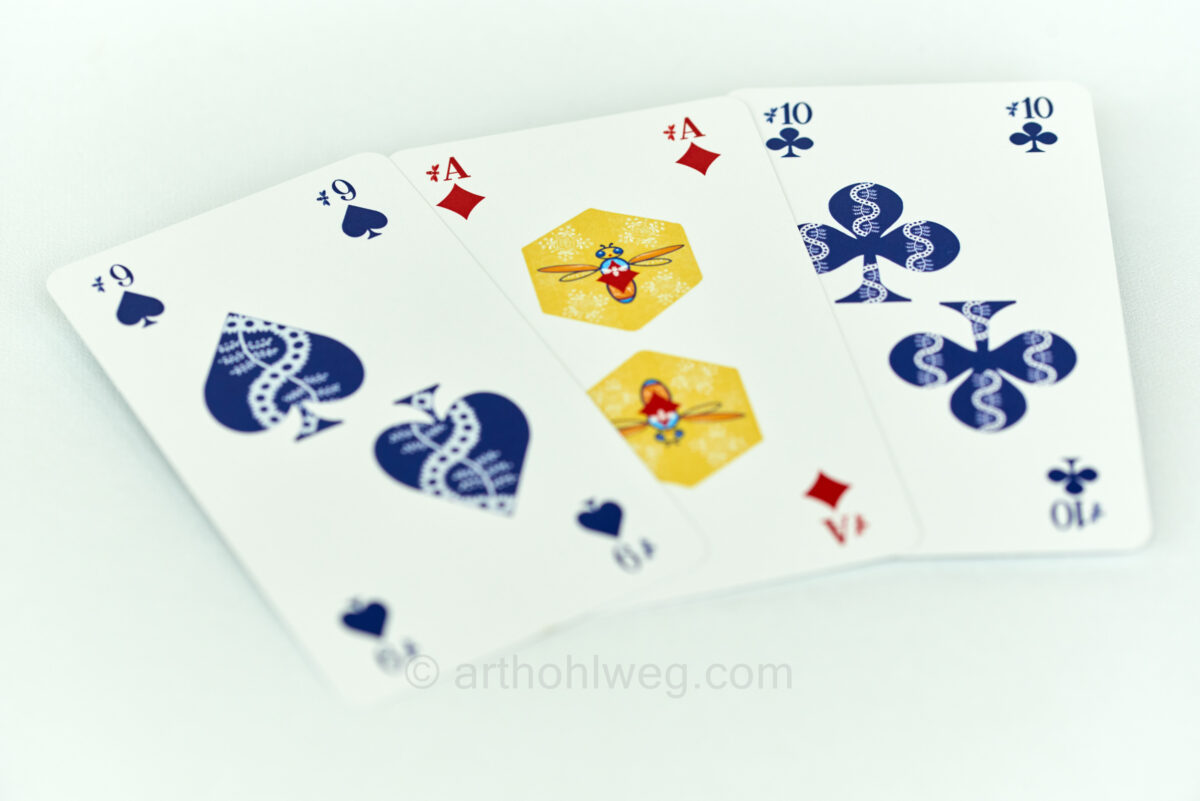
The bees seemed much more optimistic to me than my first crawling beetles. Little by little, an entire bee colony took shape. The queen bee leads the colony. The honeybee is the queen, the drone is the jack, and the honeycomb is the ace.
Each color and each card value features its own motif from the traditional Schwalenberg blue-printing tradition. The designs were created on the computer. That didn’t make the work any easier—quite the opposite. Even the smallest details opened up endless possibilities, and I took full advantage of them.
Old patterns with a new look—playable according to the familiar rules, yet with a different structure.
From an Exhibition Entry to a Deck of Cards
In 2024, MatriaSKAT was part of the “mitBLAU” exhibition in Schwalenberg. My exploration of blue printing had since evolved into a fully playable artist’s edition. The deck consists of 32 cards and is limited to 100 copies.
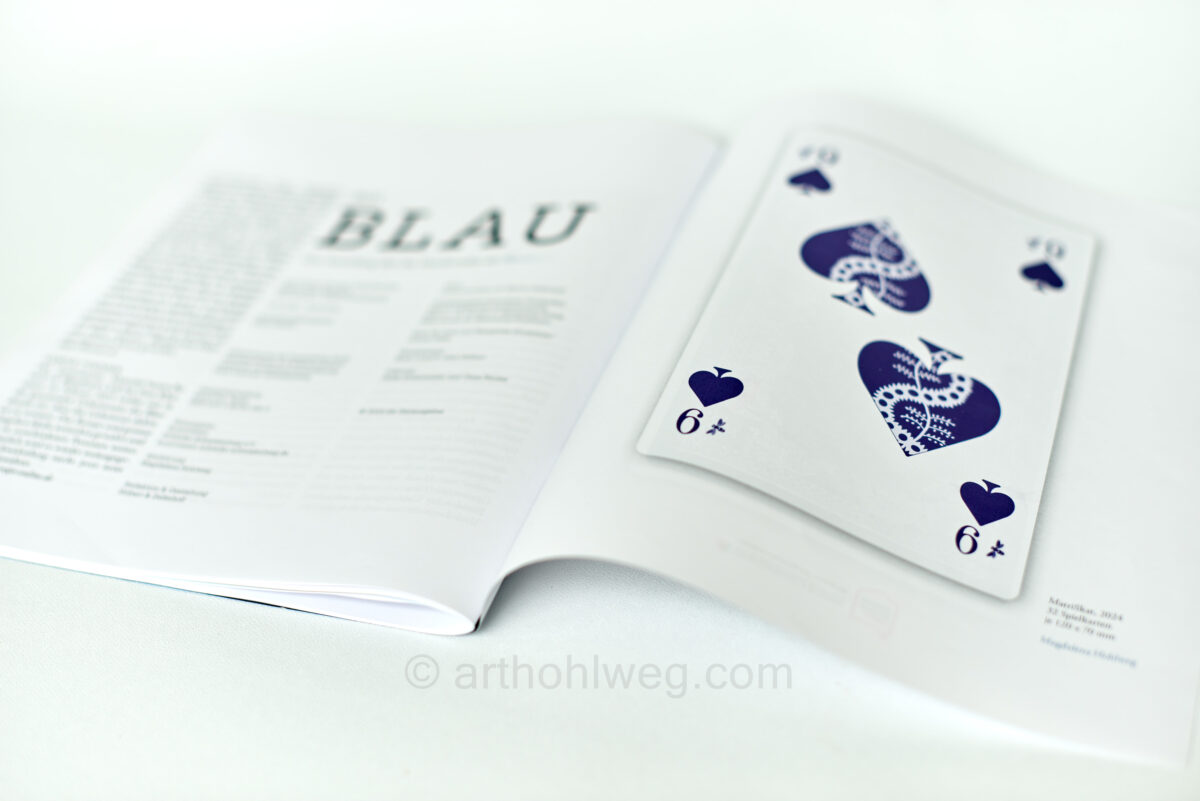
The exhibition catalog documents the creation of the work. The edition itself can be explored in more detail on a dedicated page featuring its maps, samples, and the specially designed box.
Explore MatriaSKAT Further
On the “Editions” page, I showcase the card deck as a designed object: the card faces, the backs, the box, and the special details of the limited edition.
About the “mitBLAU” exhibition · Read the personal story behind the exhibition in the journal · View the overview of art projects
