![A view of a gallery space in the solo exhibition “[UN]scheinbare Welten” at Bad Arolsen Castle. Collages and assemblages by Magdalena Hohlweg are displayed within the historic architectural setting.](https://hohlweg.de/wp-content/uploads/2025/04/FAQsw-e1743788602126.jpg)
Here I answer questions about my miniature collages and assemblages made from found objects, plant remnants, and natural materials: about their creation, durability, and framing, as well as how you can discover individual pieces in the studio and purchase these one-of-a-kind works.
Miniature collages made from found objects, plant fragments, and natural materials
1. “I’ve never seen anything like this before”—what exactly is it you’re doing?
What I do draws on several traditions without fully belonging to any one of them.
The arrangement of my insects and insect cultures in rows, modeled after scientific collections, stems from the long history of natural history illustration—the tradition of Haeckel, Maria Sibylla Merian, and Alexander von Humboldt —naturalists who not only collected and classified plants, insects, and birds, but also sought in them the interconnectedness of all things.
The combination of natural objects and everyday odds and ends—from seed pods to lost small items—evokes the concept of the old cabinets of curiosities: places where nature, art, and curiosities coexisted peacefully to tell mysterious stories—insects and birds in art have a firm place in many traditions.
What sets me apart from all these role models: My works are not documentation. My materials are not searched for – I find them wherever I go and wherever I stand. What remains is allowed to live on with me. My bird sculptures peck, hop and communicate. Miniature worlds are created from the smallest remnants – on a scale that demands a close look.
Whether as a bird scene or as insect art in collection format – each work is unique.
Unlike in a traditional assemblage, I don’t just rearrange found objects; I also supplement them with doodles and line drawings. Unlike in traditional collage, paper isn’t my primary material, but serves mainly as a support or background. I work on handmade watercolor paper using a wide variety of materials. The term “mixed-media collage” or the classification as “object art” perhaps best describes my work.
I personally like the concept of the miniature collage. That’s because every element in my work is a sculptural miniature. By rearranging the small bird figures and insect forms, I create new connections—in the miniature collages on paper.
We could also simply call it art made from found objects—from botanical fragments and traces of everyday life, somewhere between a natural history collection and a poetic narrative. But perhaps the reaction of those who see it best describes what it is: something unconventional, something that has never been seen before.
2. How did you come up with the idea to create these unique works?
One of my favorite sources of inspiration is to walk through the world as if I’ve never seen it before.
I step outside my front door and resolve to set aside every judgment and every piece of knowledge I have about my surroundings. It’s not easy—but it’s worth a try.
It’s hard for me to give a brief answer about how I come up with ideas. How much time do you have?
I’ll start by trying a version that’s as short as possible:
Give it a try yourself if you’re looking for new ideas. You might find that even when it comes to the weather, it’s hard not to judge. It gets even more exciting when I pretend I’ve never seen a tree before. Or a house. Or a leaf.
Feel free to let me know how it goes for you—I can barely keep it up for ten minutes myself. But even this brief experiment opens up a surprising amount of space for new perspectives.
The more detailed answer:
Every new development needs a learning phase and lots of experimentation – whether it’s about art, technology or science. For a long time, I explored different artistic techniques and materials. But in order to develop something truly original, at some point I had to break away from role models and learned paradigms.
I took the risk of venturing down unknown paths and freeing myself as much as possible from preconceived notions.
When I was still searching for my own artistic point of view in the 1990s, I often encountered the assertion that the development of art was basically linear. What was meant was that everything had already been researched, depicted and said – especially realism. At the beginning of the 2000s, it was considered in many places to have been completely “worked through”.
The nude, in particular, was considered to have been exhaustively explored. And indeed: the sheer number of female nudes in art history is almost impossible to take in. So why add any more? (This question may not seem central to my work, but for me it was the driving force behind forging my own path.)
There are good reasons for creating more new female nudes. One of them is that most of these nudes were created by men—and depict women as passive objects.
Unfortunately, it is still visible and tangible in many exhibitions:
I visited the Christian Daniel Rauch Museum in Bad Arolsen. The impressive, neoclassical sculptures stand there in a light-filled room, as if in an open storage area. White figures, heroic gestures, noble postures—the hall is filled with godlike grandeur. I felt surrounded by imposing figures with perfect and powerful bodies.
(Apparently, Goethe himself wasn’t entirely happy with his statue. Beneath the marble robe, his belly bulges in a rather… human way. But maybe that was just radical realism.)
Among all these heroes, however, there was one figure in this hall who clearly stood out:
, the model for the tomb of Queen Luise of Prussia.
She was the only figure lying down in the room. She radiated calm, beauty, and perfect purity. Powerful poses are reserved for the many male heroes—in art as well as in real life. Women are underrepresented. And when they do appear, it is often in passive roles.
For a long time, I, too, believed that my own perspective wasn’t worth presenting or sharing.
Today I know that it was precisely these doubts that helped me find my own visual language—and develop new, unique forms of expression.
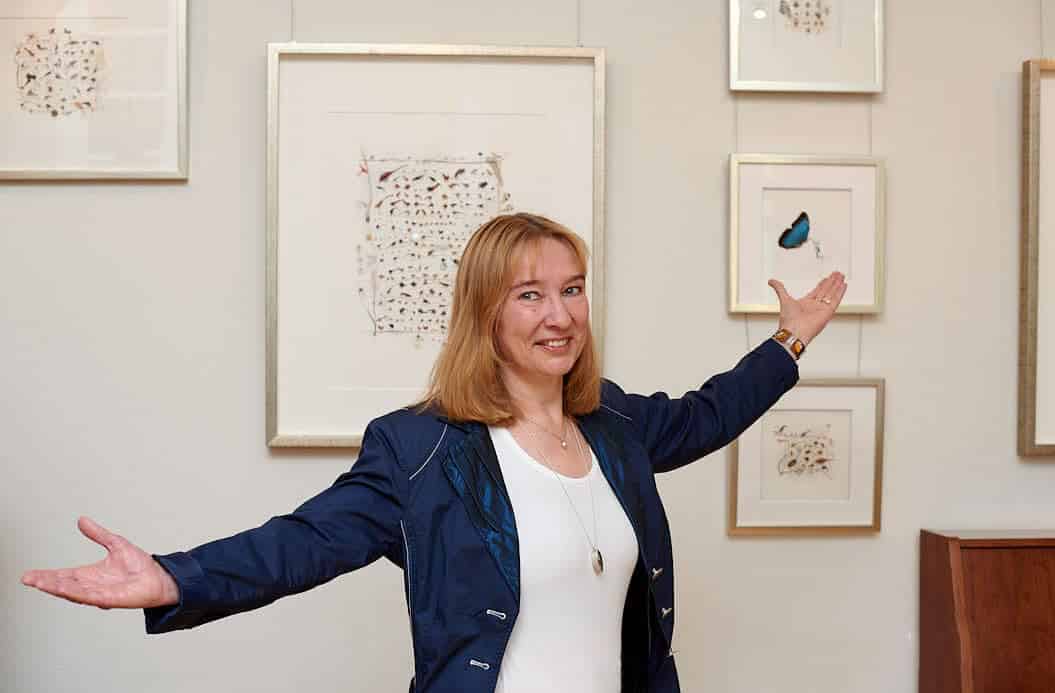
3. How long do your art installations made from found objects last?
My earliest works using plant-based found objects are now almost twenty years old.
During this time, I made an interesting observation: Some of the colored pencils I used at the beginning have faded much more than some of the plant materials themselves. Plant dyes are surprisingly durable—who would have thought?
For many years, I have therefore worked exclusively with fine artists’ pens that contain real pigment colors. In places, I dab the found objects with high-quality, lightfast watercolors to create specific accents. Incidentally, these colors also give some tiny, fragile elements a little extra stability – a kind of gentle support without taking away their independence.
However, the majority of the materials used require no treatment at all.
Like most artistic works, my exhibits should not be exposed to direct sunlight for long periods of time. Should a repair to the work or the frame nevertheless become necessary, this can usually be rectified easily. Ideally – and preferably – I do this myself.
4. the framing
…generally require a spacer so that the three-dimensional miniature collage does not come into direct contact with the glass and is not damaged or warped over time.
For this reason, many standard frames available on the market are not suitable.
Professional framing requires experience in handling delicate, mostly three-dimensional materials. I have gained this experience over many years—including through my own trial and error.
To ensure the long-term stability and durability of my work, my original art pieces therefore leave my studio only when they are fully framed.
5 The advantage of low-reflective glazing
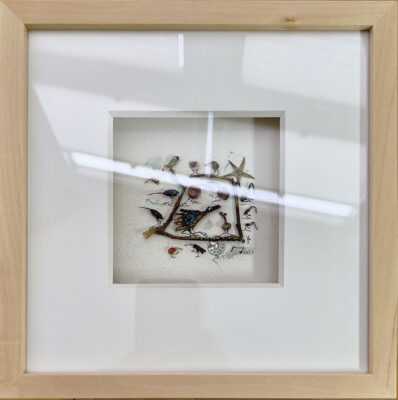
Standard glass isn’t enough to truly bring out even the finest details of my mixed-media collages. Glare and light reflections quickly obscure what the work is really about.
However, I can show the difference between regular glass and low-reflective museum glass better than I can explain it. The following picture first shows an assemblage behind standard glass.
The next image shows the same original behind the anti-reflective glass that I use for my work. This glass also provides UV protection for greater lightfastness.
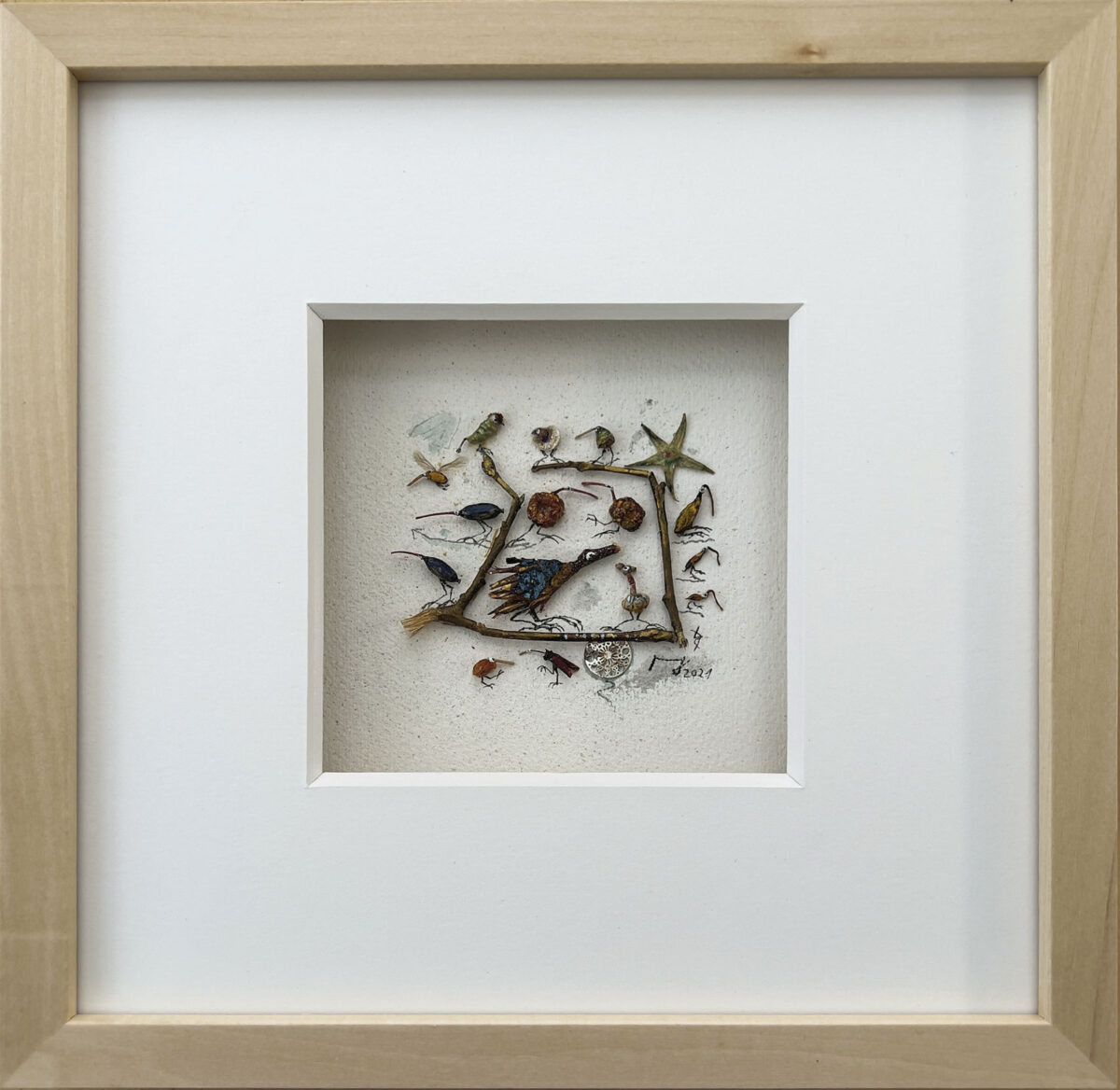
The following applies to my collages made from the smallest trifles: Only the best for the leftovers
6. are the finds preserved?
For particularly fragile finds, I let the adhesive soak in slightly—this acts as a gentle preservation method.
Another important point is the dust-tight framing: The finished exhibits are completely sealed behind the glass.
7. is a special adhesive used?
A standard, acid-free paper adhesive is used.
If you notice that there are hardly any traces of this in my work, it’s because of my meticulous approach—precision is simply a matter of practice.
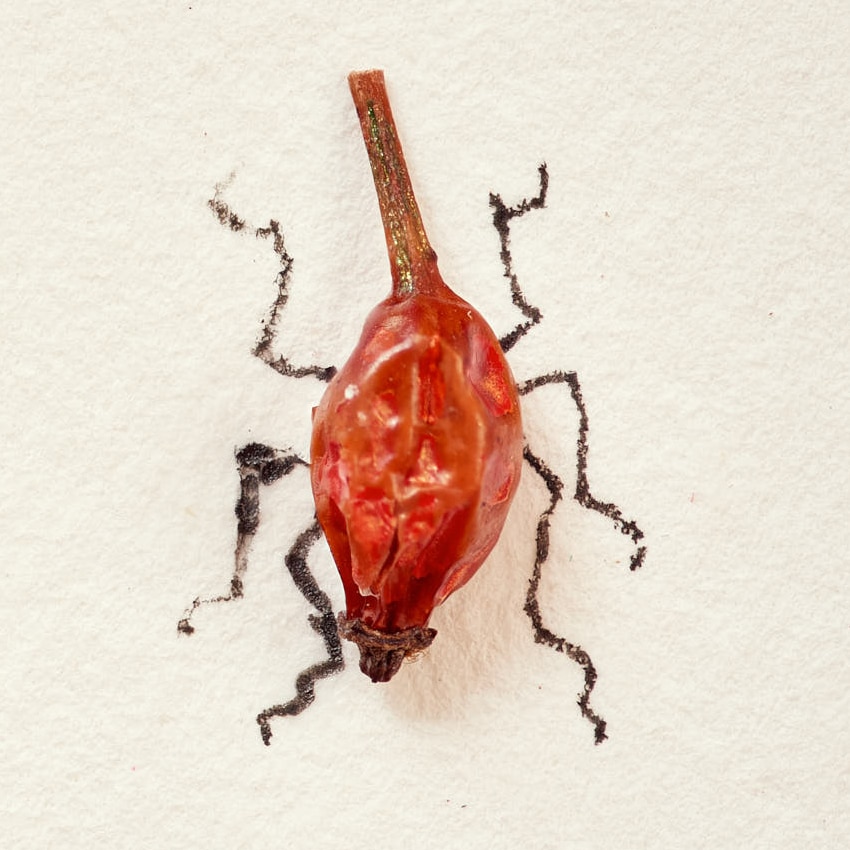
8. how long does it take to complete such a work?
To put it very briefly: Depending on the complexity and the objects I find, I estimate that it takes me anywhere from three hours to three years to complete a piece—depending on where my discoveries and finds lead me.
That’s not an easy question either. I often work on several independent scenes – a work is rarely created in a single process. As soon as I discover a suitable found object in my collection, I add it to works in progress. I move some elements back and forth several times until I am convinced of their effect and finally fix them.
Of course, collecting the finds themselves also takes time. However, I never specifically go looking for new materials. Instead, I’m constantly discovering little things in passing that I pick up – in my jacket pocket, in my wallet or in some small container. Pieces larger than about one square centimeter rarely interest me.
9. Where can I buy your one-of-a-kind pieces?
You can purchase my one-of-a-kind pieces right here on hohlweg.de —straight from my studio and from me, the artist.
Under “Acquire Artworks,” you’ll find a hand-selected collection of available object art, mixed-media collages, and assemblages. The respective artwork pages feature additional views, texts, and details about the originals.
Once you’ve logged in, you’ll see the price, availability, and shipping information, as well as the “Purchase” button. You can use this feature to complete your purchase in the integrated online store.
If you have any questions, please feel free to contact me at galerie@hohlweg.de.
10. do you also design the collages from found objects on request?
If you’d like, I’d be happy to see if your request can be combined with my collection and my own ideas.
I would especially love to receive a small object that is meaningful to you—ideally no larger than 1 x 1 cm—from which I can create a one-of-a-kind piece that cannot be replicated.
Please subscribe to my personal newsletterto stay informed about new work and developments even more easily.
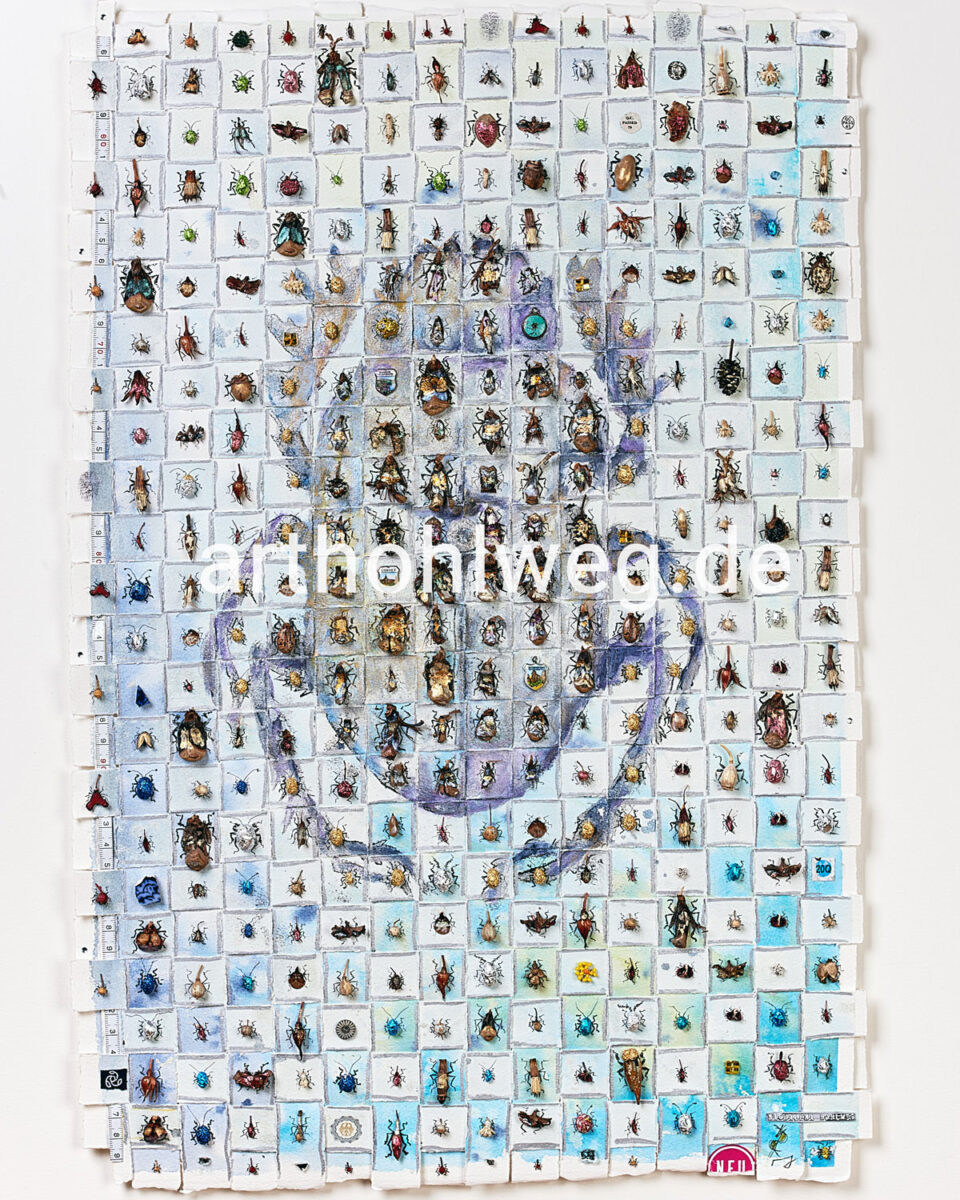
If you’re looking for wall decor, a poster, or a quick art purchase, you’ll likely find something different here than you expected. These pages aren’t meant to be a traditional store, but rather a workshop—a place where stories are created and brought to life. Each collage is an original work of art, a one-of-a-kind find with its own story. There is no mass production and no motifs that can be reproduced at will. Each miniature collage exists as a one-of-a-kind piece and bears the traces of its creative process. With my miniature art, I want to do more than just decorate walls—I want to invite you to look more closely, ask questions, and discover a story that goes beyond mere decoration.
