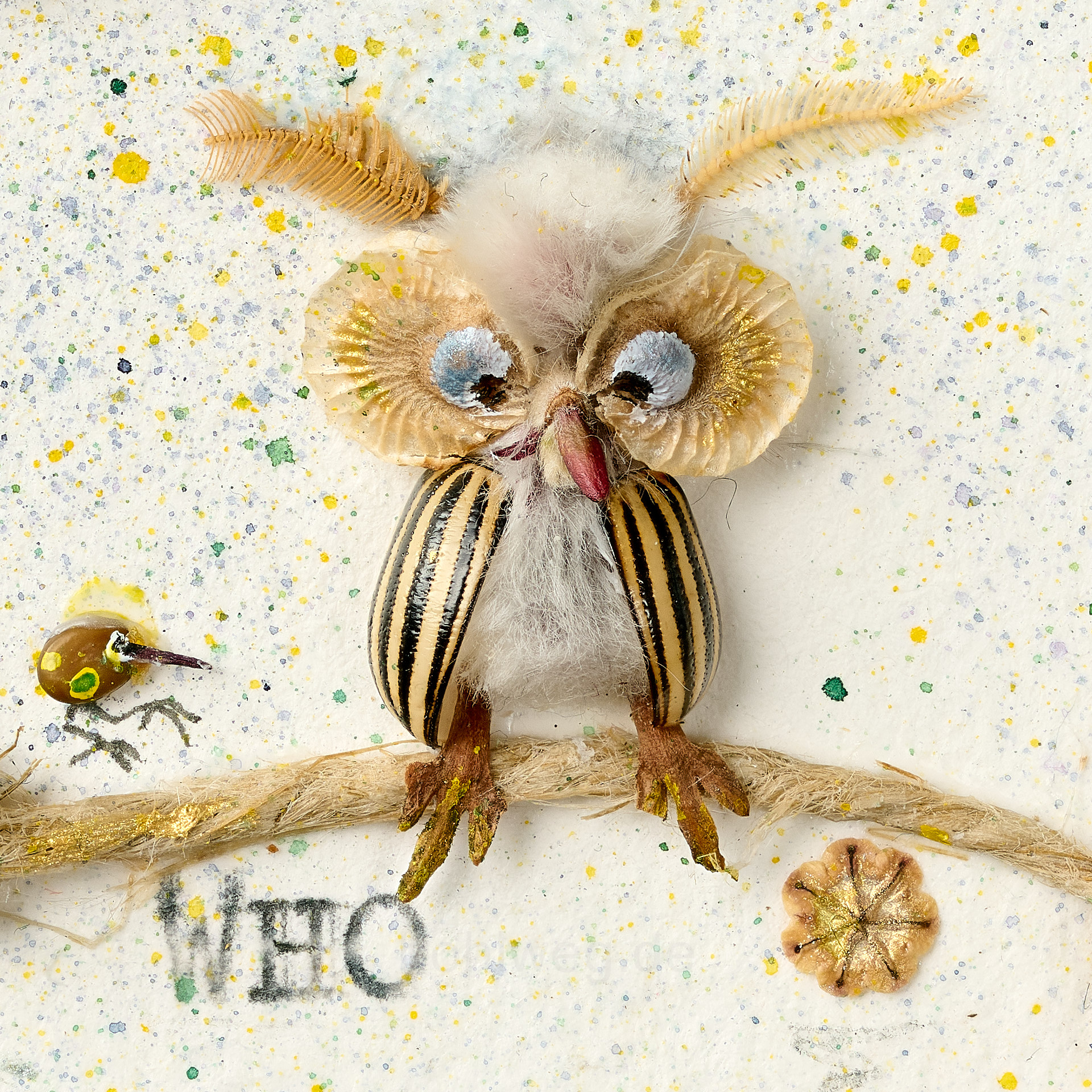
Am I cute?
A cuddly willow catkin and big, round eyes—so incredibly cute.
A little bird with a round little belly—it’s like a childhood dream that has come to life in miniature. And yes, my materials are delicate, my pieces are tiny, and my motifs are often drawn from the realm of the cute.
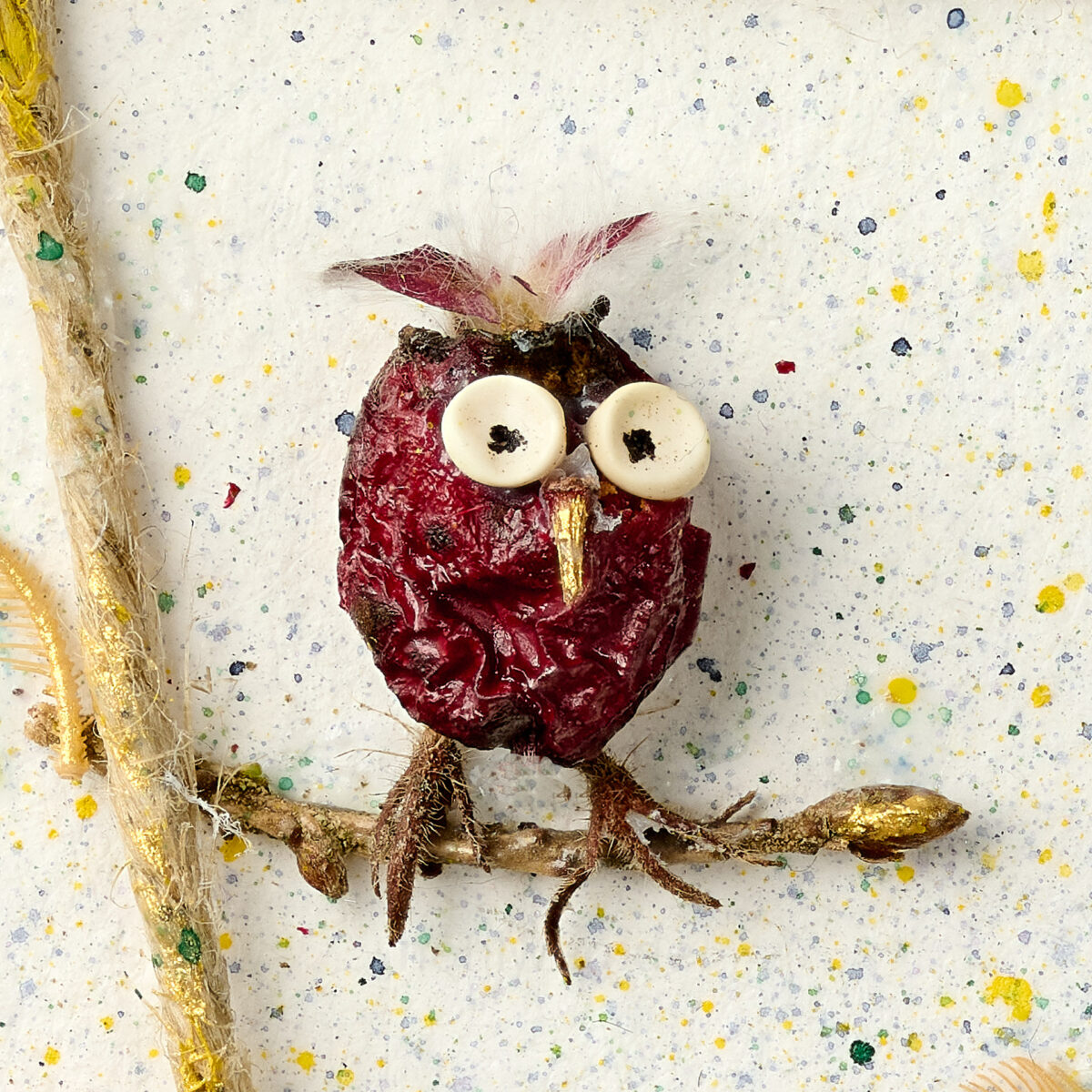
But here’s the thing: Nature, the source of these finds, uses this category to perfection—mainly as a distraction. A thistle head that, when backlit, looks like a disheveled stuffed animal is actually a structure of barbs designed to anchor itself in fur and flesh. A flower that enchants us with its color and scent is, in reality, carrying out the ruthless reproductive logic of a plant that cannot move on its own. The packaging is sweet. Behind it, there is almost always a survival strategy.
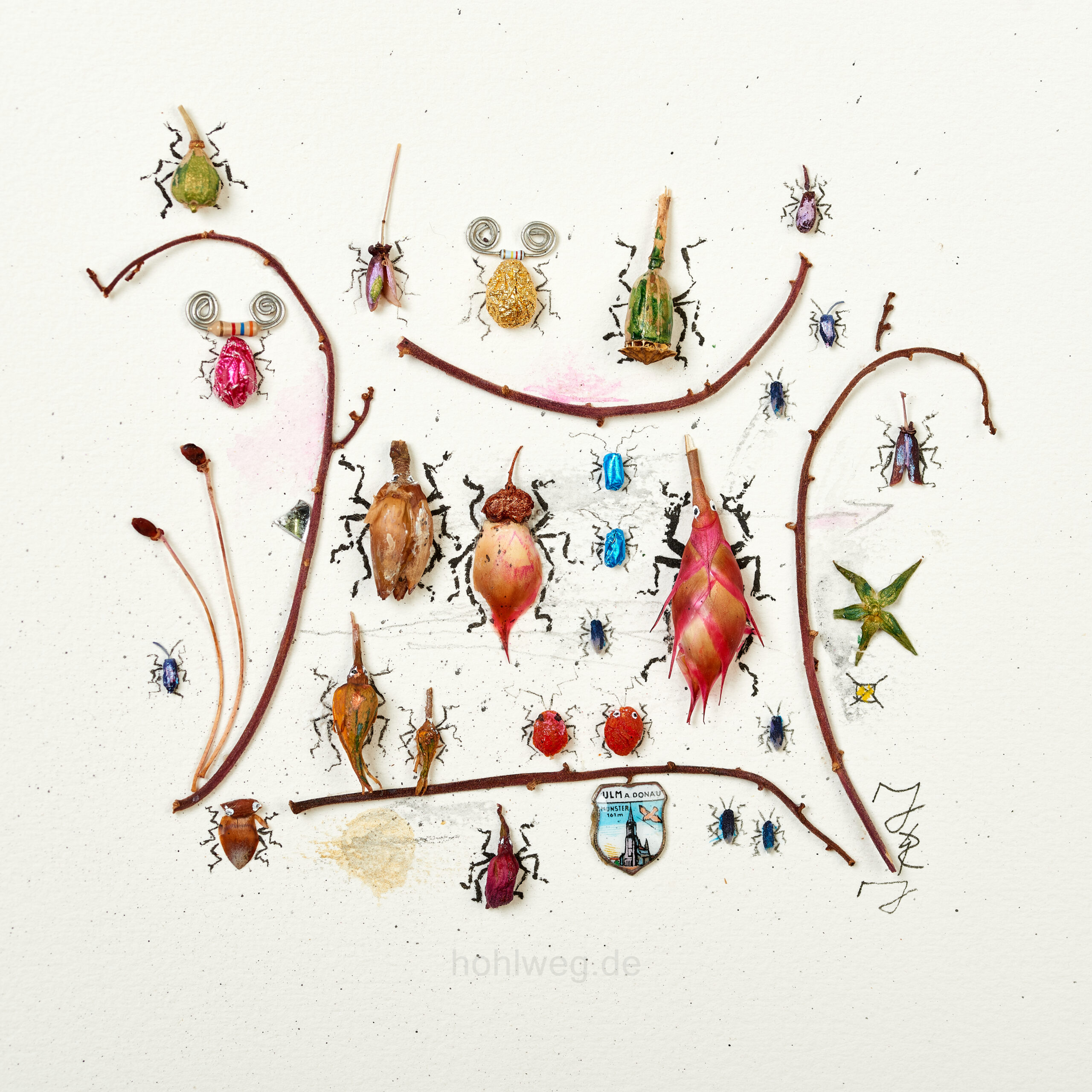
This is exactly the space I like to work in—between saccharine and morbid. My bird sculptures peck away in a comical and exuberant profusion, while our natural world is threatening to die out. My insect series are filled with cute little beetles, yet they remind us of creatures that, in real life, sting, bite, or simply make an unpleasant crackling sound when you get too close—and are also threatened with extinction.
What “Cuteness” Actually Is
A specific term for this phenomenon has now become established in art theory: “cuteness.” The American cultural theorist Sianne Ngai describes “cuteness” in her book “Our Aesthetic Categories” as a distinct aesthetic category—linked to everything that appears small, insignificant, inferior, and seemingly harmless, to what is generally perceived as subordinate, trivial, and, above all, harmless. Unlike the Beautiful, the Sublime, or even the Repulsive, “cuteness,” according to Ngai, arises primarily in relation to consumer goods and the world of commodities, born of the desire for a simpler relationship with the things that surround us.
The real twist in her theory: cuteness is rarely as innocent as it seems. Ngai describes how “cuteness” deliberately aestheticizes helplessness—and how this act of trivialization almost always contains an element of aggression, an unconscious attempt to simultaneously weaken and keep the admired object small. It is precisely this oscillation between tenderness and encroachment, between the protective instinct and a sense of dominance, that makes “cuteness” a far more unsettling category than first glance might suggest.
Cute, but not harmless—Cuteness in the Contemporary Art Scene
In Düsseldorf, the NRW Forum of Aesthetics dedicated a special exhibition format to the subject under the programmatic title “#cute. Islands of bliss?” – noting that the hashtag #cute alone is one of the most widely used on Instagram, with nearly 700 million posts.
In the exhibition “Love you for Infinity” at the Sprengel Museum in Hanover I found myself right in that space between fascination and repulsion. Before me stood an oversized, manga-style figure by Takashi Murakami, with huge, wide-open eyes and a smile that really wouldn’t hurt a fly. This figure seemed unsettling, downright intrusive in its obscenity, especially since, in this sculpture, scale itself becomes a means of expression. Murakami celebrates exaggeration.
My birds and insects remain small and reserved; you have to make a conscious effort to turn your attention to them in order to even discover what lies within them. Both approaches explore the same tension between attraction and unease, just at completely opposite levels of intensity. It’s probably no coincidence that the Japanese word for “cute,” kawaii, sounds almost like its opposite, kowai—creepy, terrifying—and Murakami’s works can indeed be classified in both categories.
Murakami juxtaposes these two poles and stages their collision on a grand stage, deliberately pitting cuteness against the eerie. I’m interested in the opposite movement. I seek the naturalness with which both sides have long belonged together—their casual fusion into a single, everyday phenomenon. In my miniature worlds, everything ordinary coexists without nature seeing anything special in it. This casual coexistence—which isn’t even intended as a contrast in the first place—interests me more than the grand gesture of confrontation. Where Murakami celebrates the dissolution of opposites by making them explosively visible, I want to show them by simply letting them happen.
Here’s another insightful article on the topic: Incredibly Cute: Cuteness in Art and Culture
London also dedicated a major group exhibition to the theme in 2024 at Somerset House, simply titled “CUTE”. And in 2025, the Kunsthalle Erfurt asked this question in its exhibition “The Cute Escape” asked quite directly whether art featuring soft forms can offer harsh criticism—and when affection turns into something political or even radical. It’s also noteworthy how strongly the word “cute” is associated with a traditionally feminine sphere—and with kitsch.
Where My Work Begins—and Where It Doesn’t
At this point, I see my own miniature worlds in the best of company, but also with their own unique twist. The current “cute art” movement mostly draws its motifs from internet culture, toys, the world of comics, or digital imagery. My found objects, on the other hand, have already withered, been lost, or broken before they even reach me. In my work, cuteness meets real decay.
The art world has traditionally had a problem with the cute. Heroic marble figures, massive historical battles, tragic nude figures—these are considered significant. A palm-sized object made of seed pods and scraps of jewelry, on the other hand, is quickly dismissed as arts and crafts, decoration, or a nice touch for the living room. Yet a carefully composed miniature collage involves observation, time, and risk. The fact that it is precisely the small, delicate, and potentially “cute” that is less often taken seriously probably says more about art history than about the objects themselves.
“Am I cute?” is my invitation to take a closer look—so that the real plan can be revealed beneath the cute surface.
