
On Herons, Mud, and the Art of Observation
Over the past few days, we’ve really indulged in winter once again. Walks through storm-swept snowdrifts, the crunch of our footsteps, and then that silence—soft and muffled, as if we had cotton in our ears—the full package, right here.

Well, that’s over now. The roads are clear again, as are the railways, and yes: that’s definitely a relief.
What remains is the thaw. And with it, that peculiar mixture of slush, gray, and a certain sense of disillusionment with the landscape. The world suddenly seems like an unfinished sketch that someone has been tinkering with using wet brushes.
This thaw isn’t exactly something to swoon over.
But then—in the midst of this dreary monotony—something remarkable appears
Something white.
Too white for this slushy weather.
Too striking to ignore: my gaze wanders absently over the gray-brown fields as I ride in the car (as a passenger, I’m allowed to do that). Suddenly, there’s an unusually bright streak in the landscape, seemingly untouched by the dirt all around it, as if it had nothing to do with any of it.
Do you know that moment when your eye catches something and your brain hasn’t quite caught up yet? Is that a pole? A plastic bag? A scrap of agricultural stretch film that’s ended up in the wrong place?
But no.
It’s moving.
It takes a step.
You hardly ever see it in the city. But out in the countryside—along damp meadows, by fields, or near country roads—it can suddenly appear: a large bird of an incredible white, making no effort whatsoever to blend in and instead standing out brilliantly against its surroundings.
The Great Egret.
The first time, I was certain I was seeing a vision. That radiance. That serenity. That almost otherworldly elegance. As if he hadn’t landed here on purpose, but had just stopped by briefly by accident. A being straight out of a delicate Japanese drawing. A gossamer-thin, pure-white silhouette, cut out from the gray-brown reality.
A feathered dream in white—truly beautiful enough to make you melt.
But why is the great egret actually called a “great egret,” when it neither glistens silver nor seems as clumsy as its better-known cousin, the gray heron? Probably because a name like “divinely white angel bird,” “radiant feathered angel,” or “deer-legged forest light bird” simply wouldn’t do justice to its close relationship to the heron family. (You can find out more about the great egret here.)
You’ve probably seen the gray heron before. It often stands motionless by streams, in parks, or by garden ponds. Its silhouette is as easy to overlook as a forgotten umbrella, even as it has already devoured the entire goldfish population without anyone noticing. And when it finally takes flight with a croak, it looks like a submarine with wings, rising heavily out of the water. Of course, the gray heron is also a beautiful, striking wading bird. But its appearance is nowhere near as radiant and majestic as that of the great egret.
Despite all their differences, there’s no denying their close kinship. Just like the gray heron, the great egret stands knee-deep in the mud, lying in wait for its prey with its dagger-like beak. Its pristine white plumage, however, attracts attention more quickly. That’s why it tends to stay away from our garden ponds.
It remains a remarkable sight, whose grace calls for the stillness of vast landscapes. And anyone who shines so brightly out of the gloom must surely have something to say: the great egret is apparently a herald of Buddhist teachings—after all, it is said there:
The most beautiful lotus plants grow in the thickest mud
The great egret is just the same: in its quiet yet unmistakable way, its beauty and elegance shine through precisely where you least expect them. A radiant moment that rises from the gloom—if you’re willing to look.
Enough gushing…
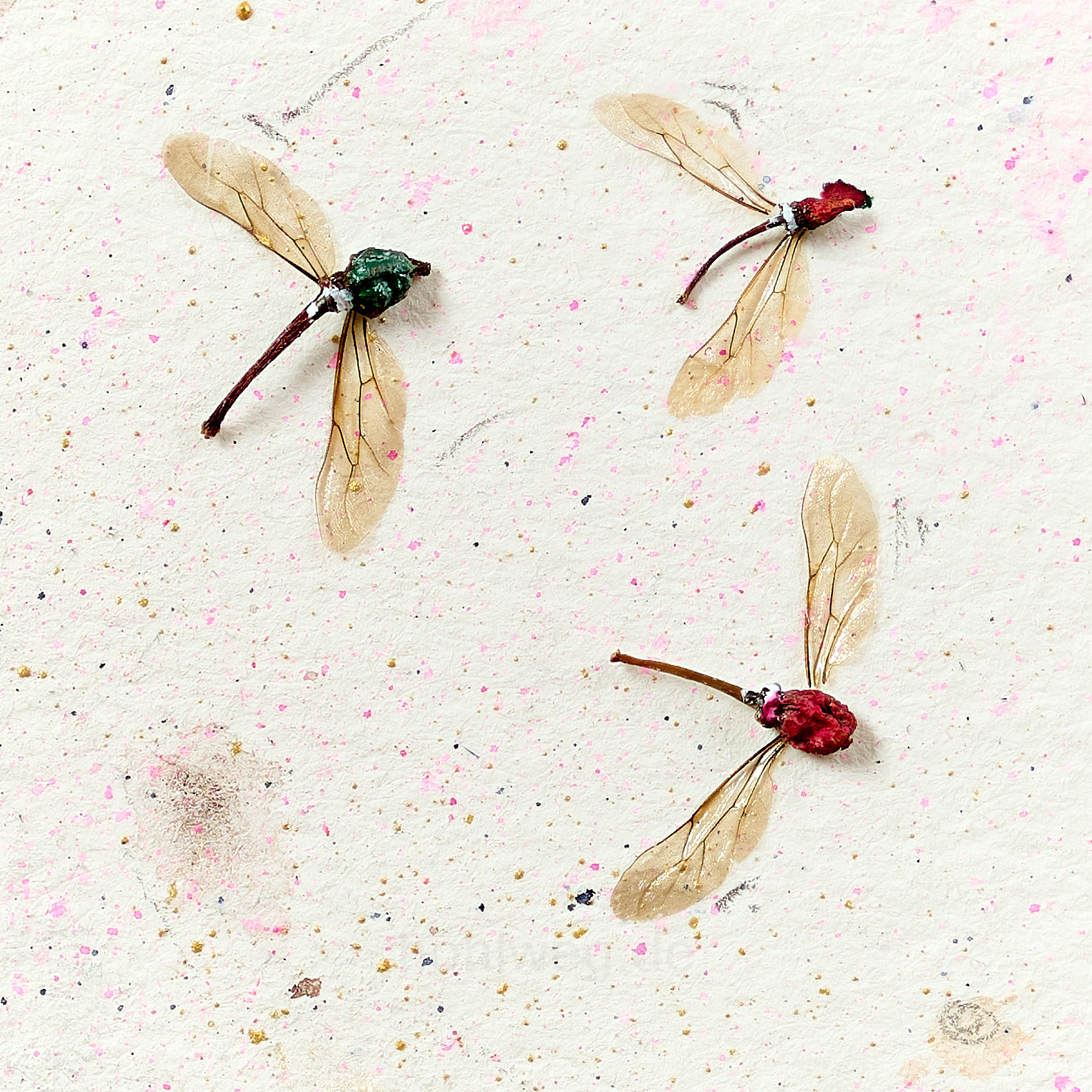
Because I actually wanted to show off my new creation. And as we all know, a picture is worth a thousand words.
Here you can see a few more minor characters…
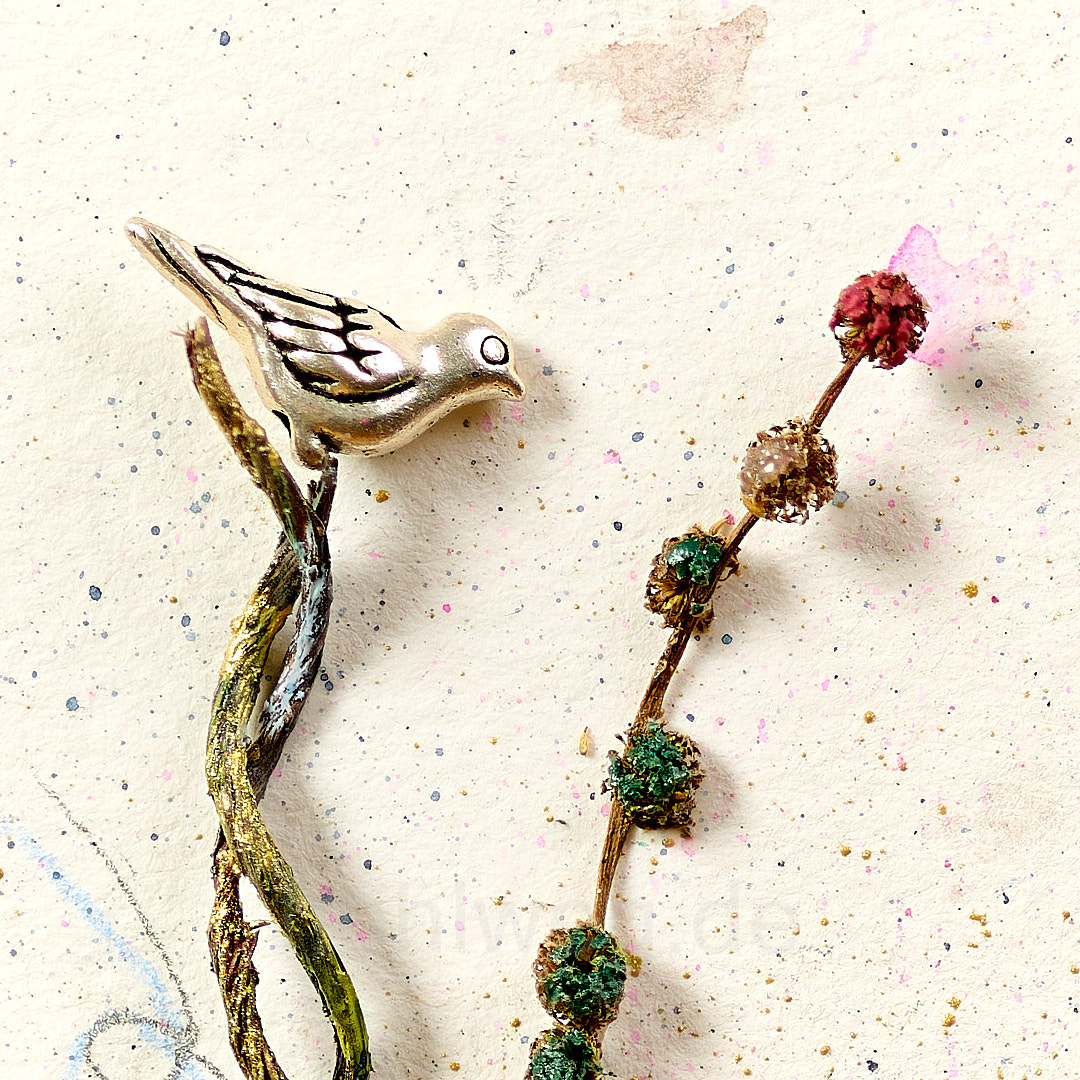
Unlike the great egret, this onlooker is actually silver:
But oh well—I’m getting lost in the details again.
So here is the entire scene. As always, any resemblance to actual people is purely coincidental.
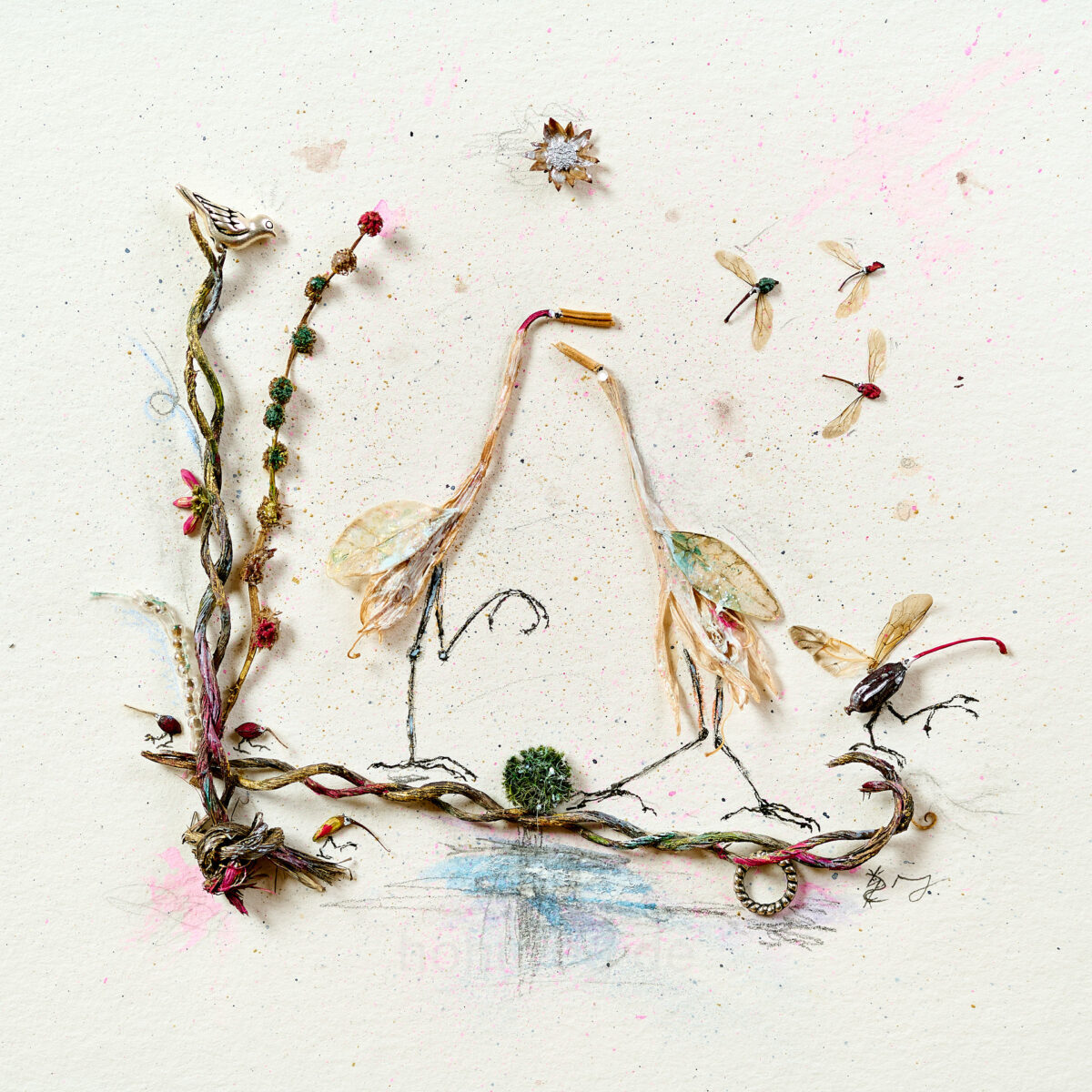
I’m not quite ready to settle on a final title for these little creatures made from flower remnants, nestled in a landscape of woven, found grasses. The framing is also still up in the air. More on this to come—I promise.
The collage presented here marks the beginning of a new series. Two more scenes will complete the series—featuring further unexpected discoveries in places and at times that, on the surface, seem unremarkable.
But I’ll tell you all about that in the next newsletter.
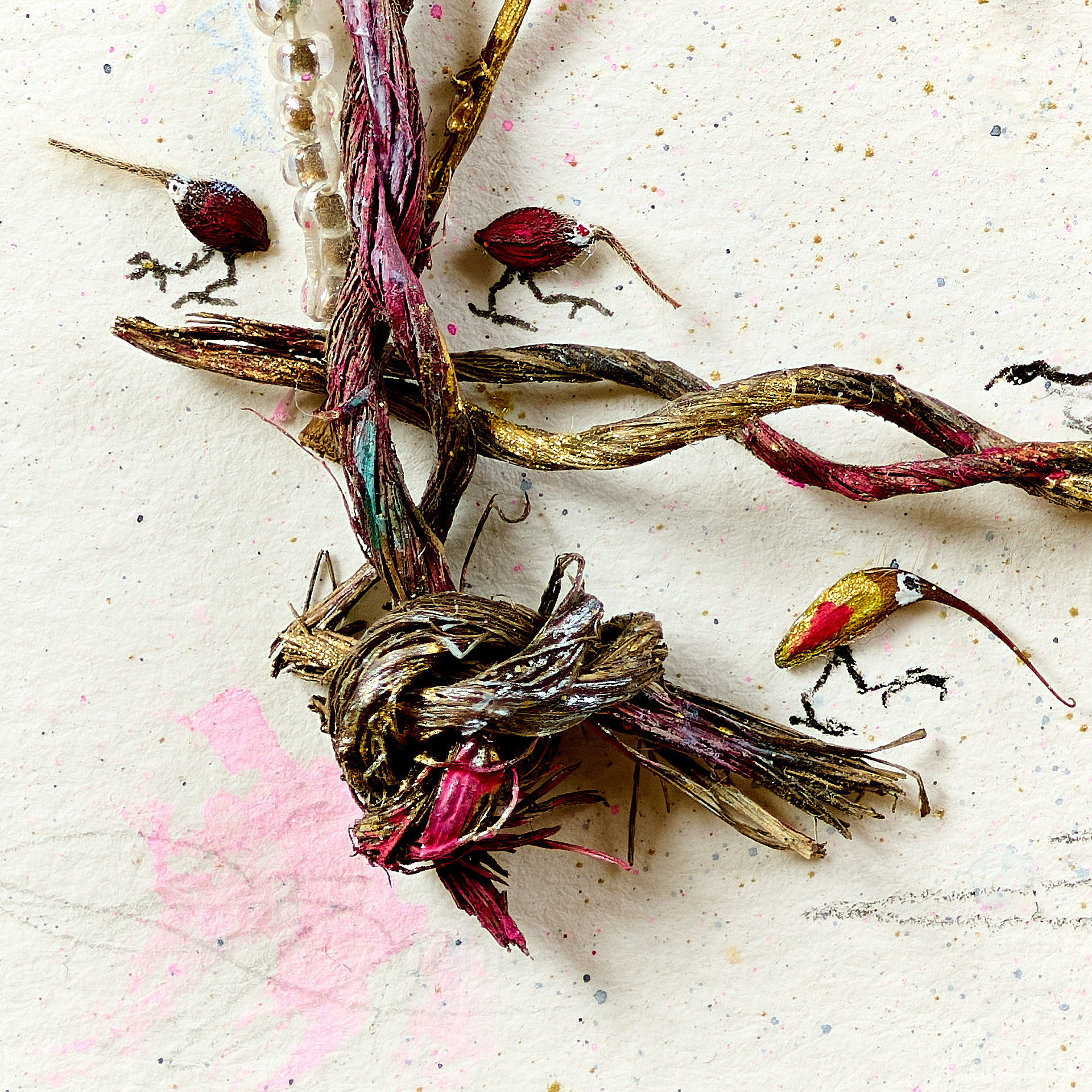
And because I just can’t stop thinking about the tiniest details, this post ends with one last excerpt: the barberry stilt.
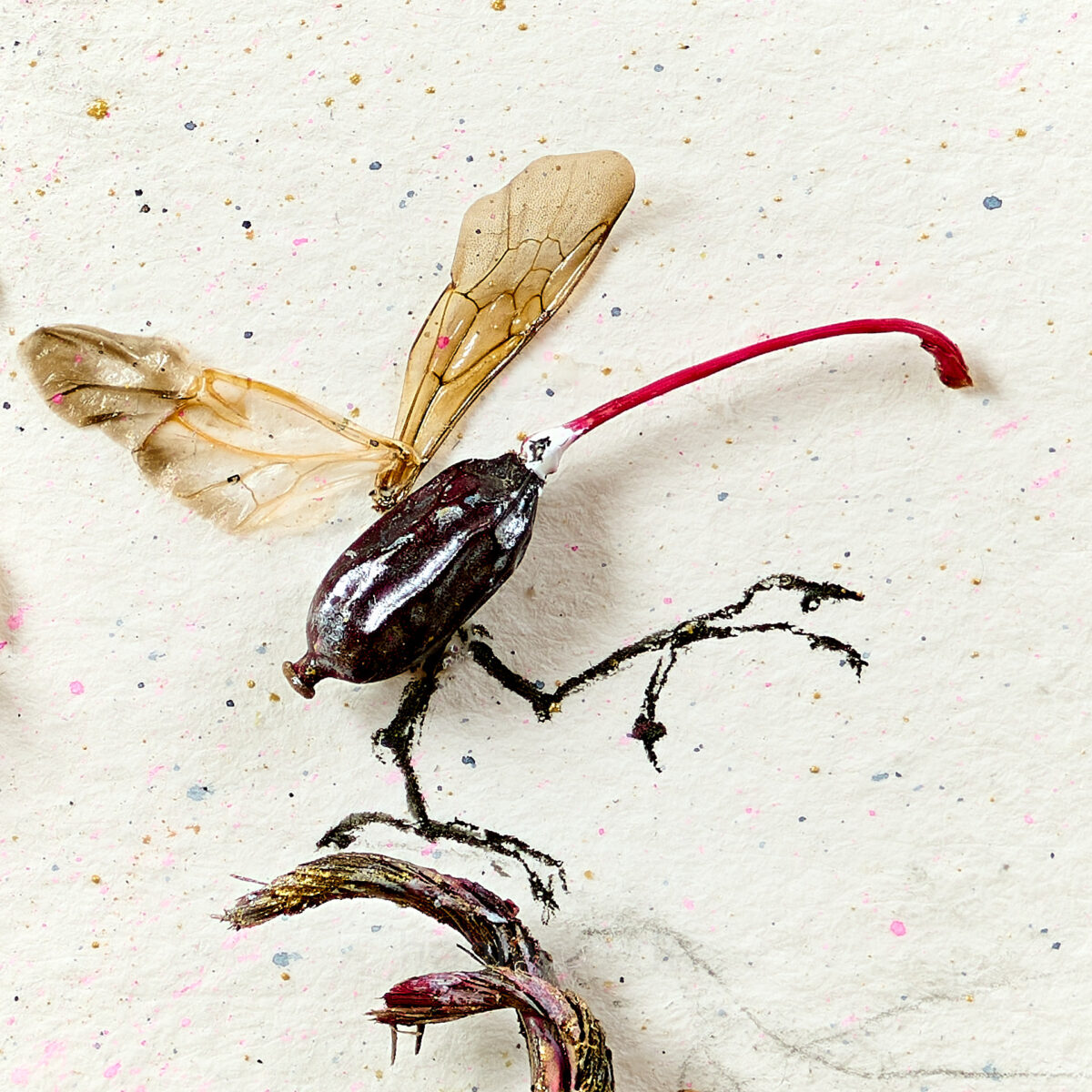
The journey of the collage series continues—stay tuned by signing up for the newsletter.
If you’d like to learn more about the inspiration behind this trip right away, you can read more here —from the frustration of gray days to the new ideas that come with the dark season.
With best wishes
Magdalena

Leave a Reply