Group of works
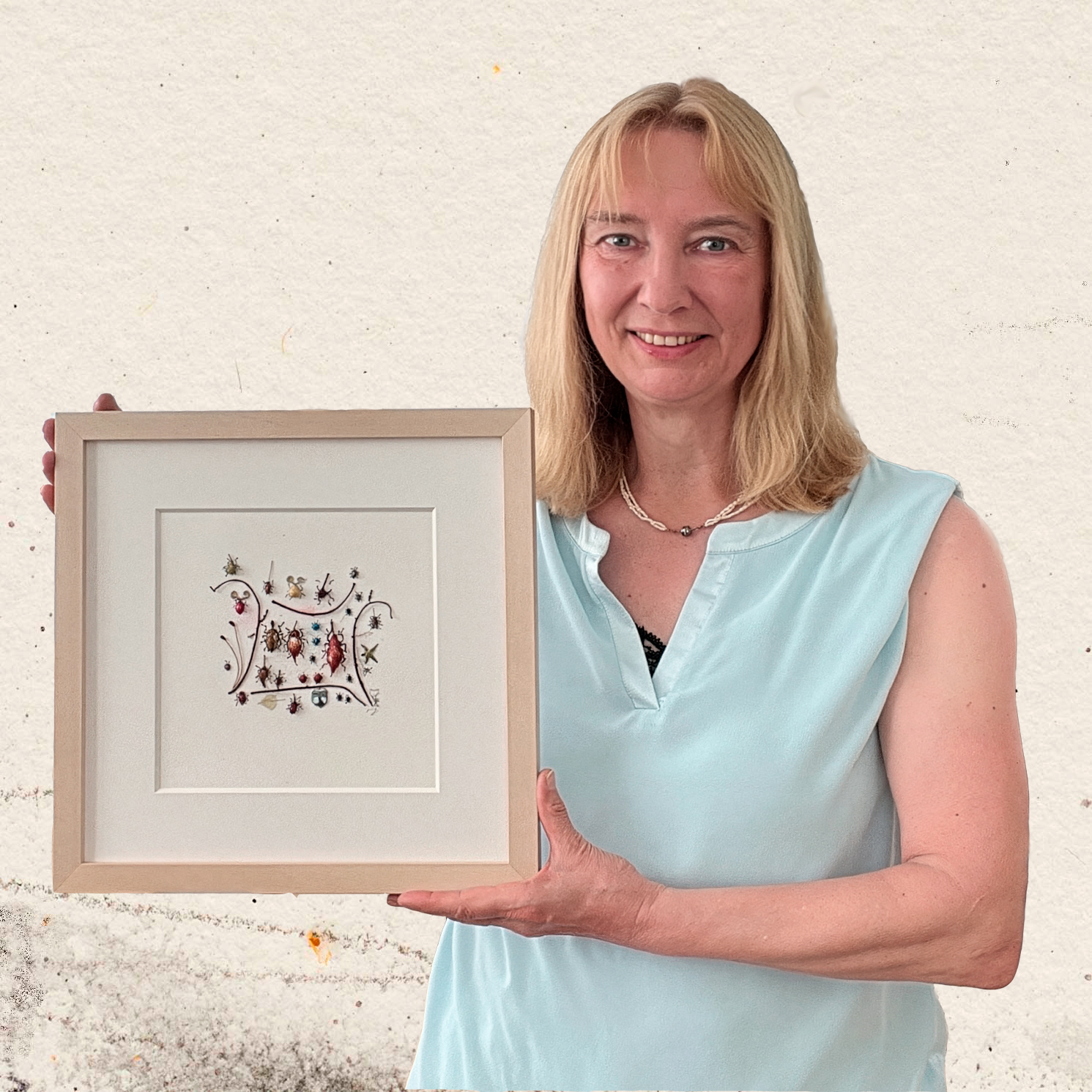
Tell me where the bugs are
Unique – including certificate of authenticity
Framed with anti-reflective museum glass
Space and effect
The work can often manifest itself in different ways in the room.
Size, distance and light determine how the collages are perceived – not just as isolated objects, but as part of a situation. Each work in this group unfolds its effect on its own or can form its own small order as an ensemble on the wall.
The photograph shown conveys this relationship and perhaps gives an impression of how the work is in dialog with its surroundings – placed on the wall or closer to the viewer. Further views allow the structure, details and composition to be discovered more precisely.
Change of perspective
Sometimes I step outside the door and let the world affect me in a way that goes beyond the everyday. Perhaps I manage to see past the obvious…
Inconspicuous fragments can suddenly reveal themselves as small treasures. For the smallest finds, there is then a space in which they can be something else. This shift can sometimes reveal something new. The inconspicuous appears mysterious, the discarded seems to tell new stories.
This often opens up a space in which I can discover new perspectives – on the material, on the world and on myself.
This view gives rise to works such as this series: small settings that perhaps slow down the gaze and allow it to perceive things anew. This is particularly evident in the juxtaposition of the collages in this group of works – similarities seem to emerge, differences become perceptible and the gaze can begin to wander freely
Effect and scale
The collage Tell me where the bugs are of the work group often only reveals its presence on closer inspection. The works are small-format, deliberately restrained and invite you to get closer. Structure, material and subtle nuances only reveal themselves on closer inspection.
The framing creates a self-contained pictorial space that looks like its own habitat. Organic found objects and everyday fragments meet as equal elements. The surprising combinations create a field of tension in which nature, everyday fragments and art can coexist.
This impression is often reinforced in the series: return and deviation stand side by side without explaining each other. The change of distance – stepping back, coming closer, comparing – can become part of the observation.
Each work is framed dust-tight (anti-reflective museum glass) and comes with a signed certificate of authenticity.
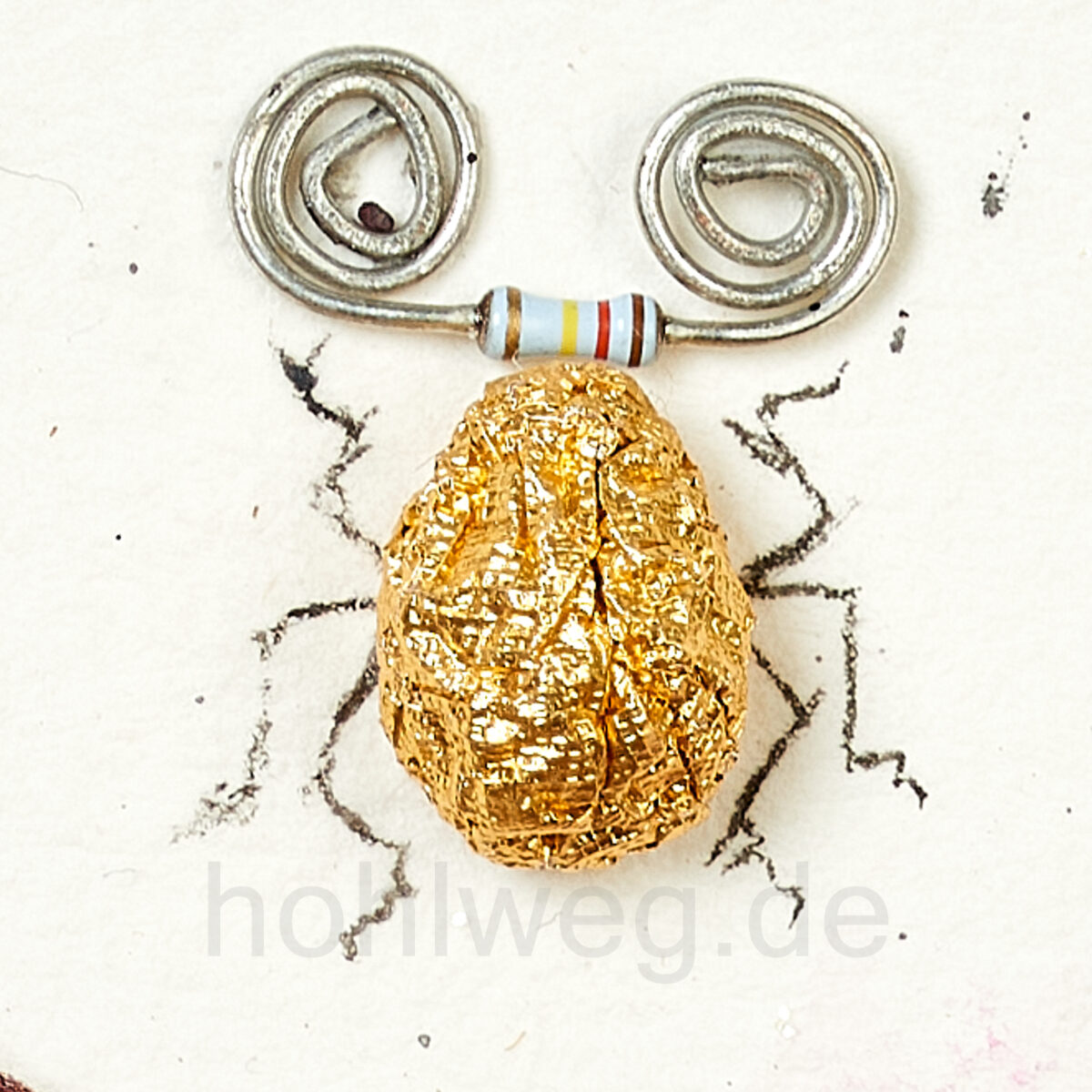
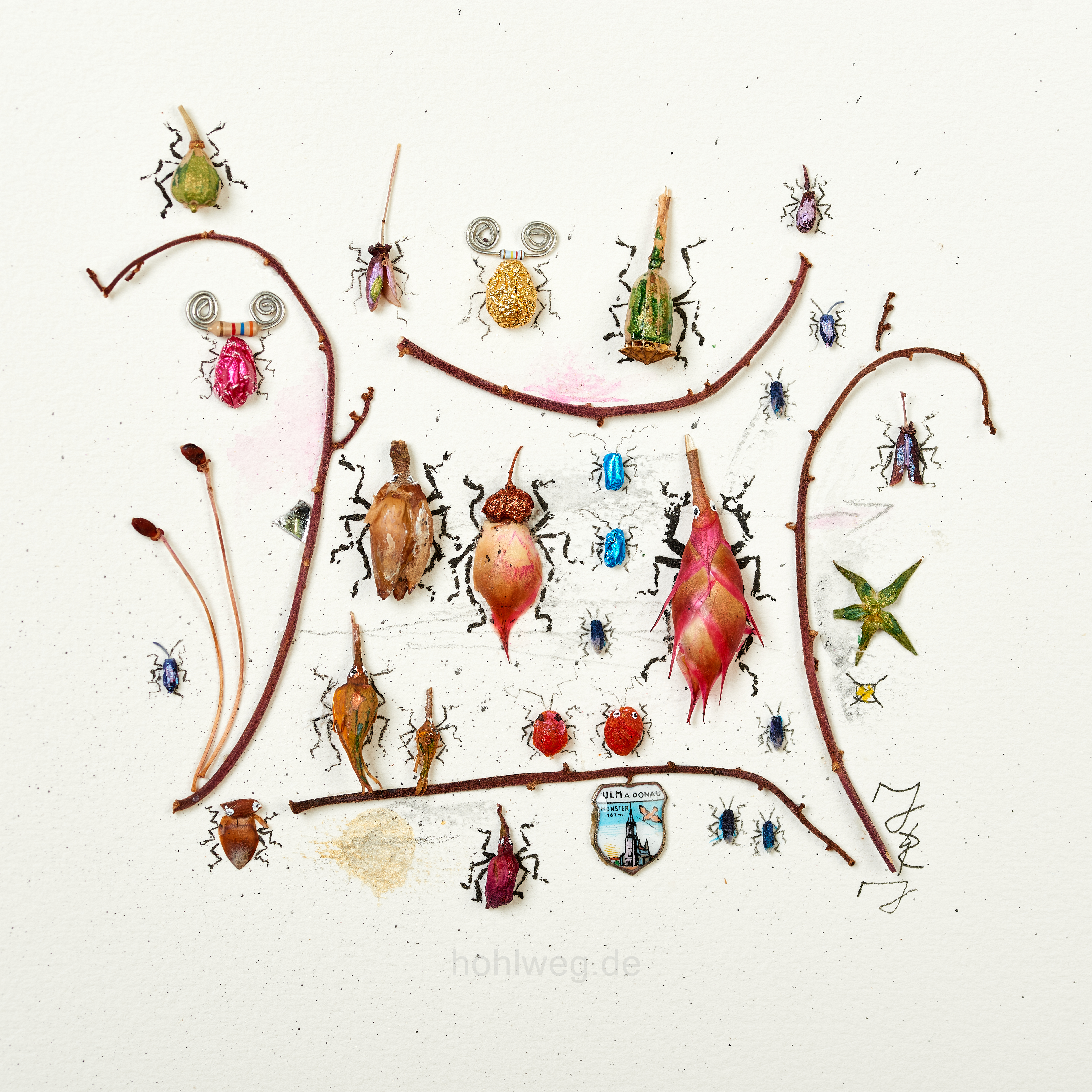
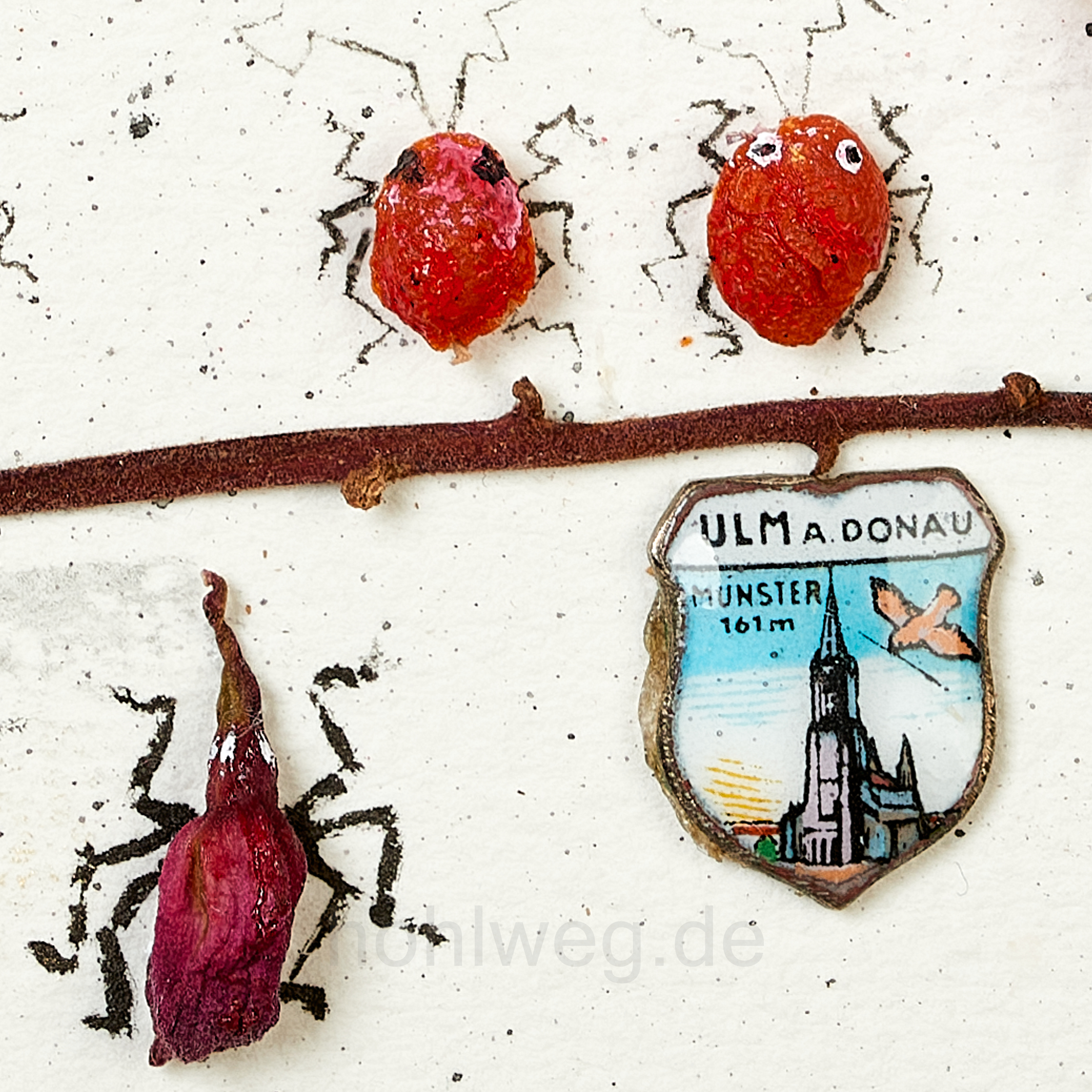
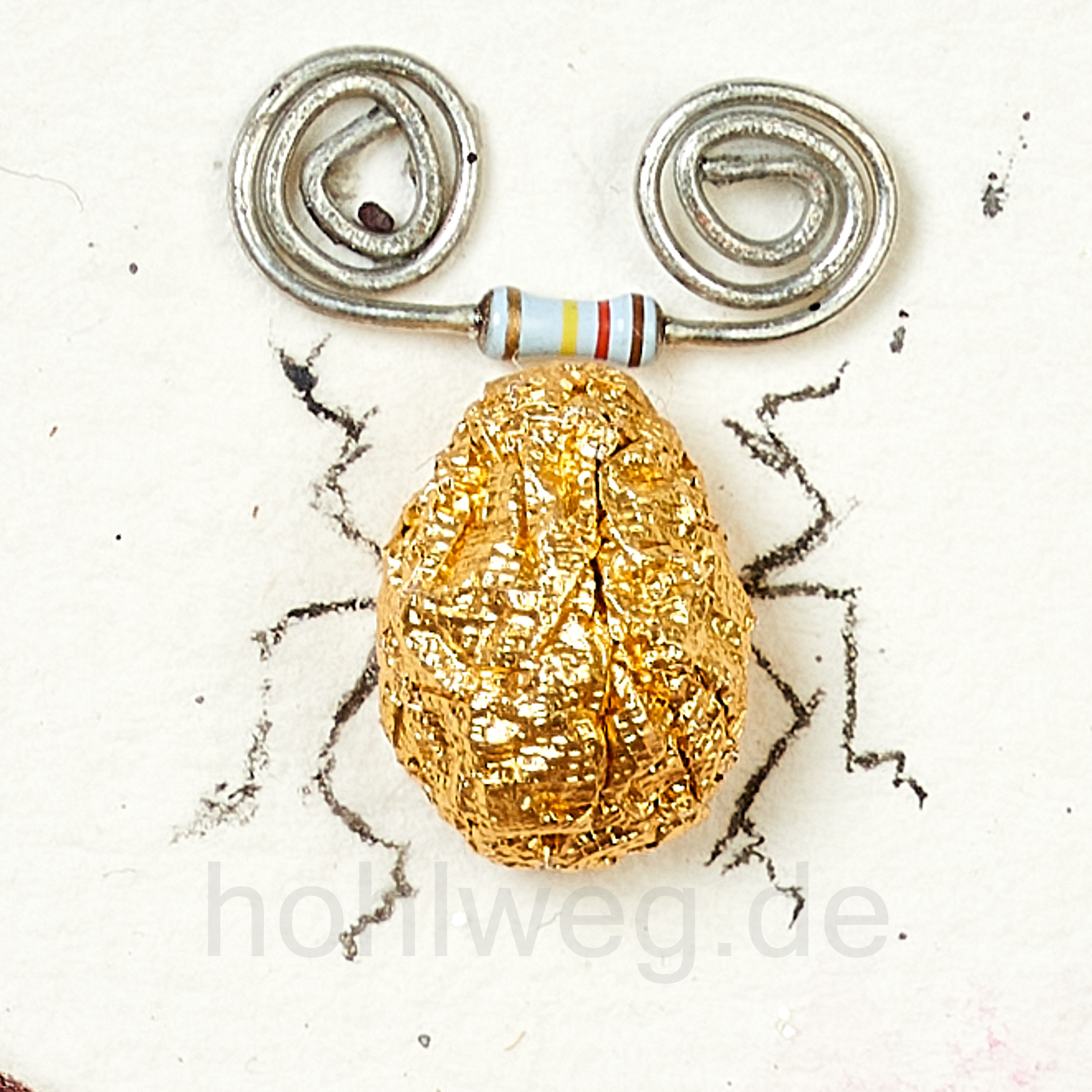
If you look closely, you will discover shiny chocolate beetles and crawling gemstones with scribbled legs.
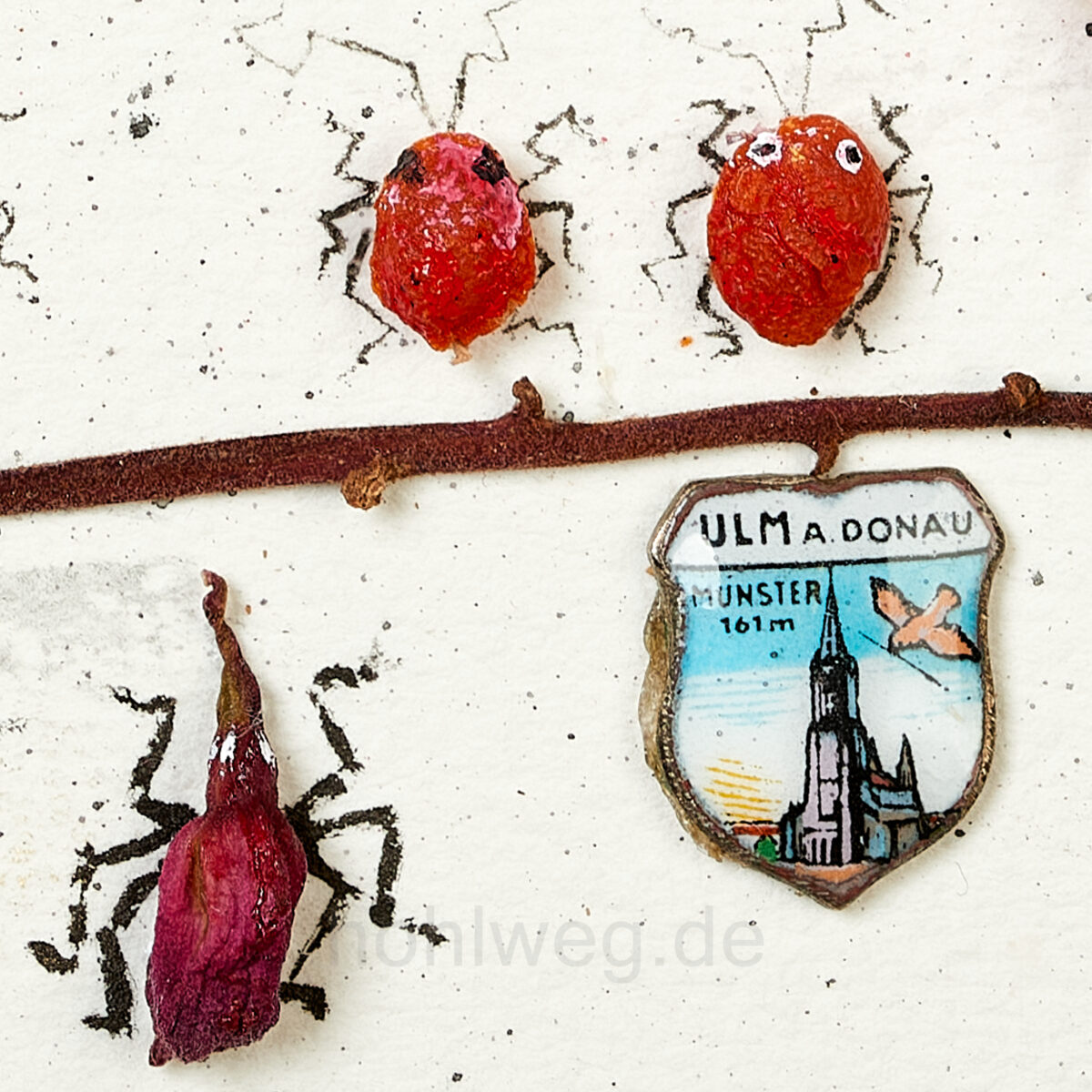
A small branch of dogwood. Spindle tree berries. Heather blossoms, a linden blossom, tomato leaves. Rosebuds, very small. Chocolate wrappers—the shiny ones you’re supposed to throw away, but which, unsurprisingly, I couldn’t bring myself to throw away. Electronic resistors, whose wires I twisted into spirals. And lo and behold: the tiny shard of a Christmas ornament, which only now caught my eye with its silvery sheen on my work table.
That was the material. So far, so innocent.
Beetles emerged from the chocolate paper – with antennae made of electronic resistance wires, which now radiate a dignity like the horned rams. Some beetles have the body of a tiny rosebud. Others owe their shape to the fruits of the peony. Anything else? Oh, yes – the smallest beetles are made from heather flowers.
Little branches of dogwood entwine the entire scene in lively twists and turns—an airy home that is both a frame and a wilderness. Tomato greens have settled like an evergreen star, landing at the edge of the delicate structure. A linden blossom joins in the play. And a few other plant remnants that wish to remain incognito—not everything here needs to be identified down to the last detail, and I respect that.
To summarize: If you don’t look closely, you won’t actually see anything else of significance here.
A small enamel find that lends weight to the whole scene. It is more than a casual indication of location. More like a clue. An answer to a question that urgently needs to be asked. So if someone asks you: “Tell me where the bugs are!” Then you now know the answer: In Ulm and around Ulm and around Ulm.
Work data
Weitere Informationen zu Preis, Verfügbarkeit und Erwerb werden nach der Anmeldung angezeigt.
Zum Werkraum-Zugang
| Attributes | Value |
|---|---|
| Weight | 0,300 kg |
| Work type | Assemblage, Miniature collage |
| Series | New love |
| Material | Found plant remains and small pieces of waste arranged and preserved on watercolor paper |
| Technology | Assemblage / Collage |
| Dimensions (object) | 13 x 12 cm |
| Passepartout | Acid-free, natural white, cut-out 19 x 19 cm |
| Glass / Protection | Low-reflective museum glass with UV protection |
| Frame | Natural wood lime |
| Overall size (incl. framing) | 33 × 33 cm |
| Condition / Processing | Dust-tight seal, suspension available |
| Suspension | The frame is fitted with a single-point suspension |
| Edition | Unique |
| Certificate | Certificate of authenticity (signed) |
