
About herons, mud and the art of looking
Over the past few days, we have once again indulged in winter to the full. Walks through stormy snowdrifts, the crunch of footsteps and then this silence – soft and muffled, as if you had absorbent cotton in your ears – the full program, here you go.

Now that’s over. The roads are clear again, as are the rails, and yes, that is certainly a relief.
What remains is a thaw. And with it this special mixture of mud, gray and a certain scenic disillusionment. The world suddenly looks like an unfinished design that someone has been trying out with wet paintbrushes.
This thaw is not something to melt away in.
But then – in the middle of this dingy monotony – something remarkable emerges
Something white.
Too white for this muddy weather.
Too present to ignore: my gaze wanders lost in thought as I drive across the gray-brown fields (as a passenger, I am allowed to do this). Suddenly, there is an unusually bright line in the landscape, seemingly untouched by the dirt around it, as if it had nothing to do with anything.
You know that moment when your eye gets stuck and your head has to follow? Is that a pole? A plastic bag? A piece of silage wrap gone astray?
But no.
It moves.
It takes a step.
You hardly ever see it in the city. But outside, along damp meadows, in fields or near country roads, it can suddenly appear – a large bird of incredible whiteness that makes no effort at all to camouflage itself and instead stands out brightly from its surroundings.
The Great White Egret.
The first time I saw it, I was sure I had an apparition. This glow. This calm. This almost unearthly elegance. As if he hadn’t landed here with a plan, but had just stopped by by accident. A creature like something out of a delicate Japanese drawing. A delicate, pure white silhouette, cut out of the gray-brown reality.
A feathered dream in white – truly melt-in-your-mouth beautiful.
The great egret actually looks far more elegant and doesn`t look as clumsy as its better-known cousin, the gray heron? Nevertheless – a name like “divine white angel bird”, “radiant feathered angel” or “deer-legged forest light bird” would simply not do justice to its close relationship to the heron family. (You can find out more about the great egret here).
You will have already seen the gray heron. It often stands motionless by streams, in parks, by the garden pond. Its shape is as easy to overlook as a forgotten umbrella, while it has already eaten the entire goldfish population unnoticed. And when it finally takes to the air, cawing, it looks like a submarine with wings rising ponderously out of the water. Of course, the gray heron is also a beautiful, striking walking bird. But its appearance is nowhere near as bright and sublime as that of the great egret.
Despite all their differences, the close relationship cannot be denied. Just like the gray heron, the great egret stands knee-deep in the mud to ambush its prey with a dagger-like beak. However, its pure white dress attracts attention more quickly. That’s why it likes to stay away from our garden ponds.
It remains a special phenomenon whose grace demands the stillness of wide landscapes. And anyone who shines so radiantly out of the gloom must have something to say: the great egret is obviously a herald of Buddhist teachings – after all, that’s what it says:
the most beautiful lotus plants grow in the thickest mud
The great egret is just like that: in its quiet but unmistakable way, its beauty and elegance shine out exactly where you least expect it. A shining moment that rises out of the gloom – if you are prepared to look.
Enough raving…
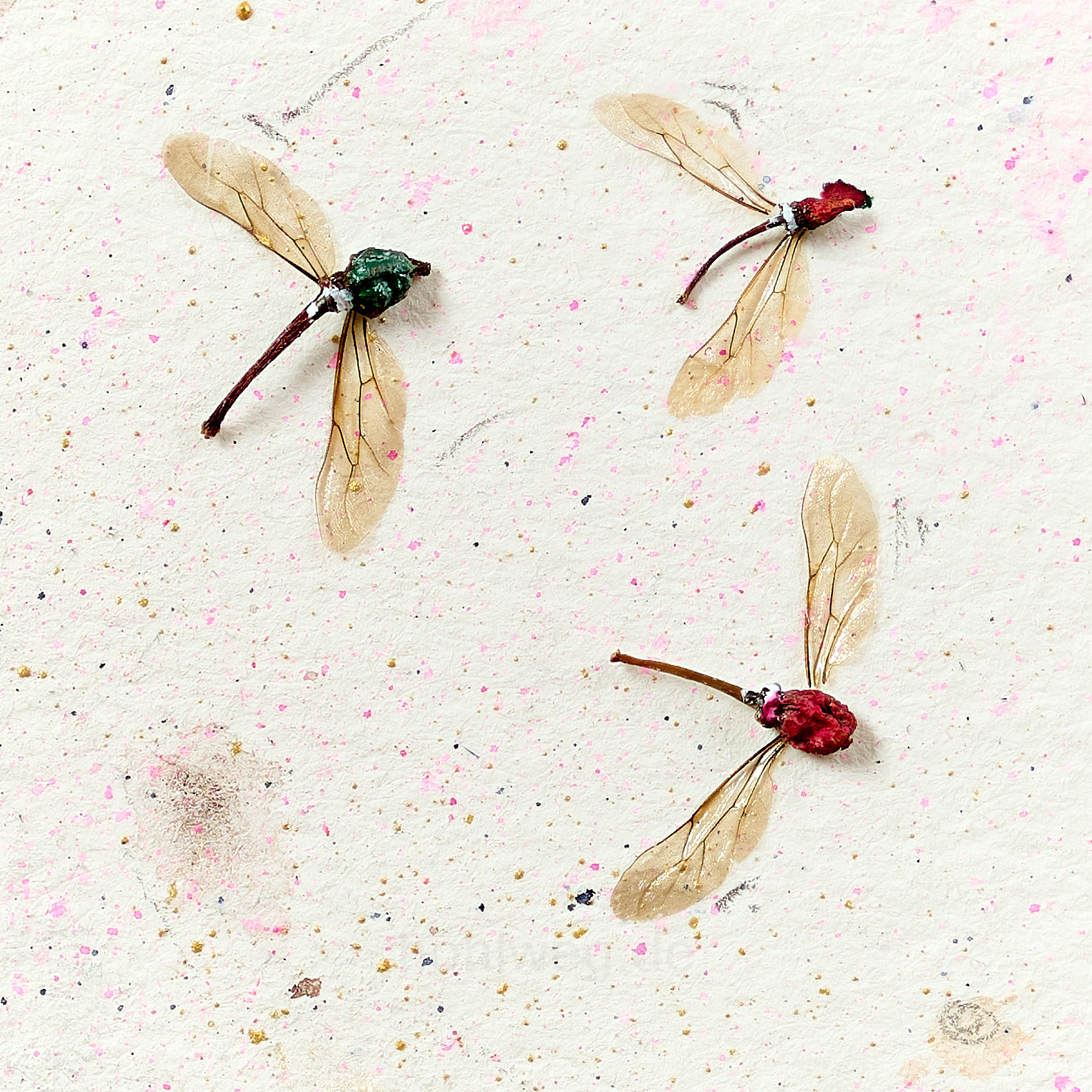
because I actually wanted to present my new work. And as you know, a picture is worth a thousand words.
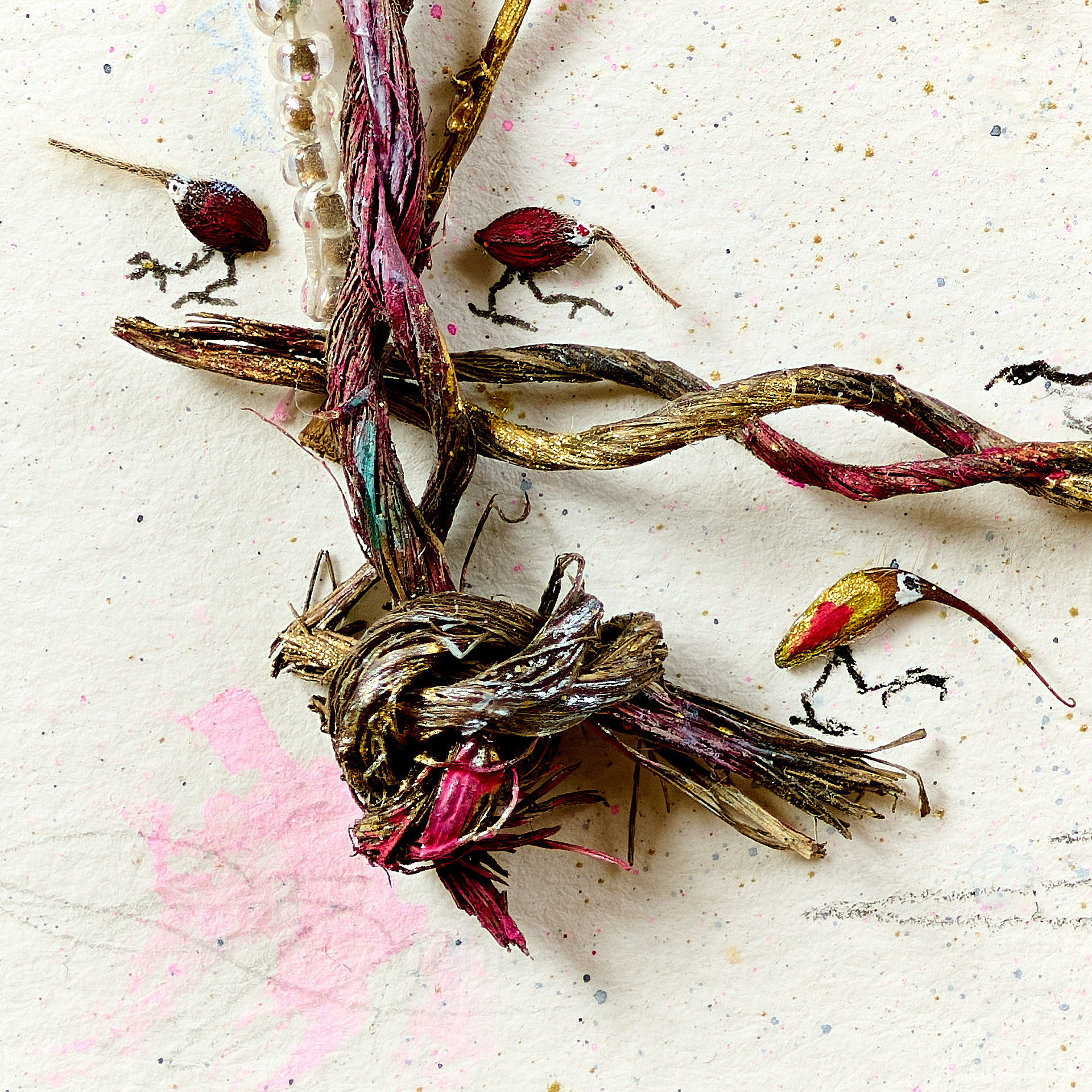
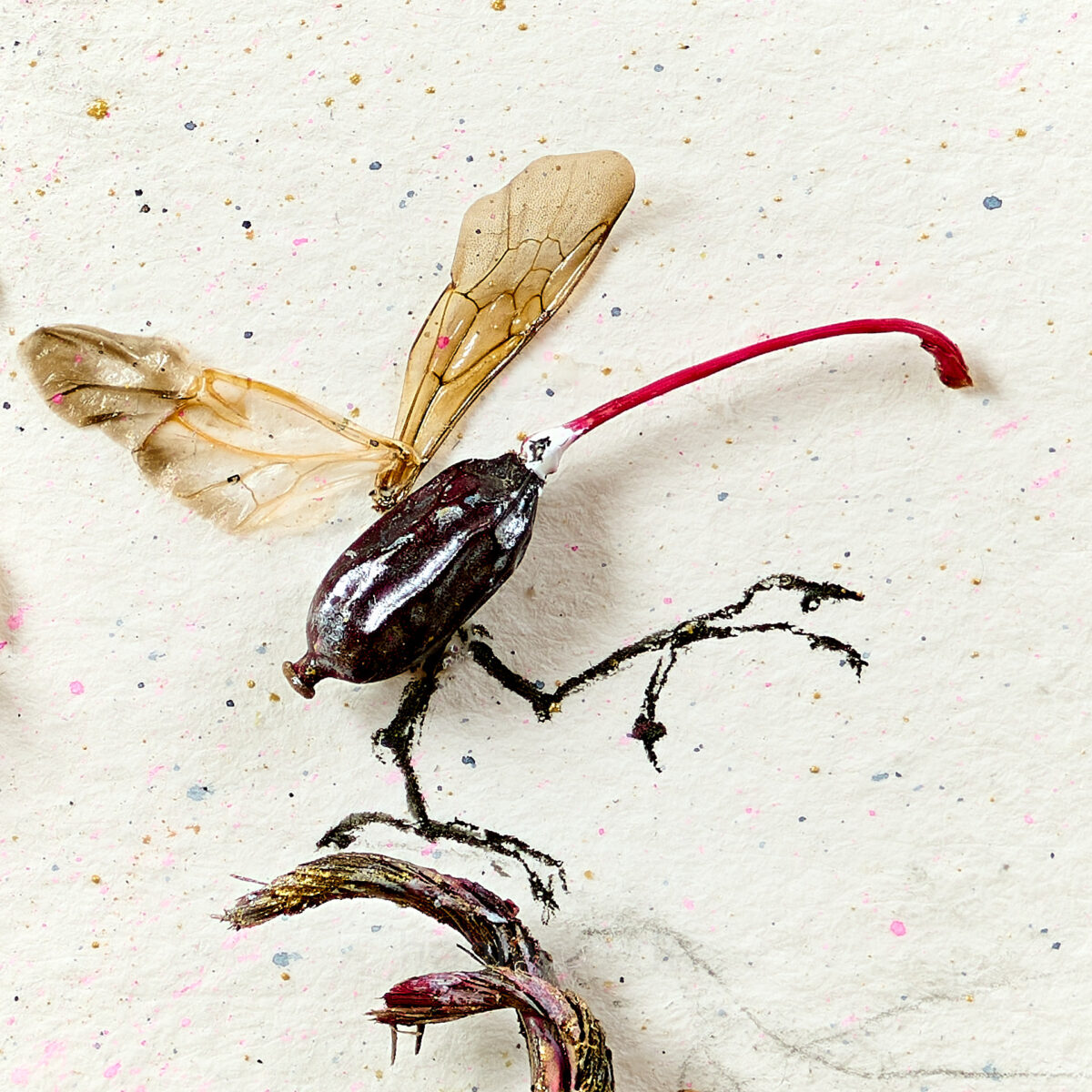
Here you can see more small marginal figures…
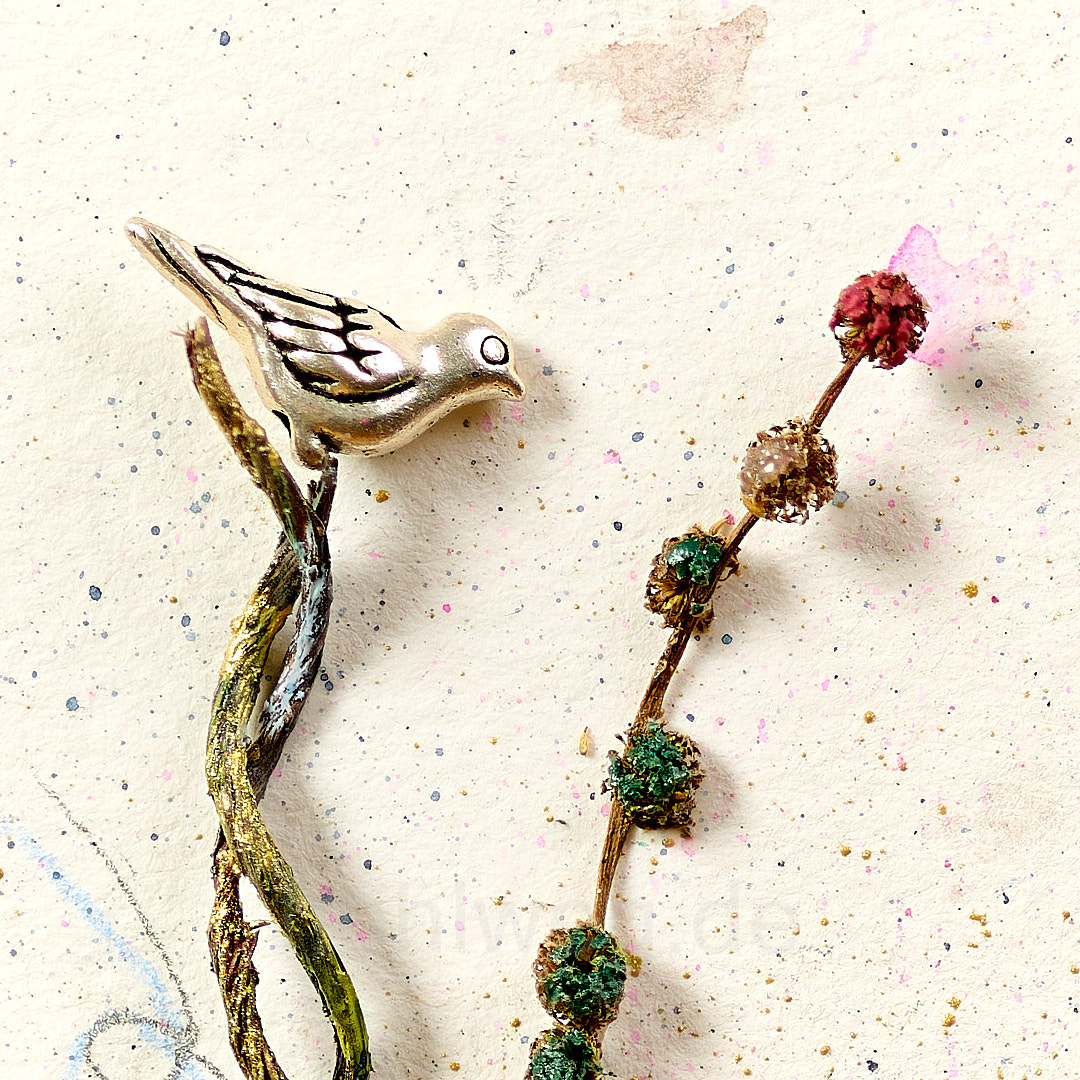
In contrast to the great egret, this fence guest is actually silver:
But oh – I’m getting lost in the details again.
This shows the complete scene. All similarities with real-life figures are, as always, purely coincidental.
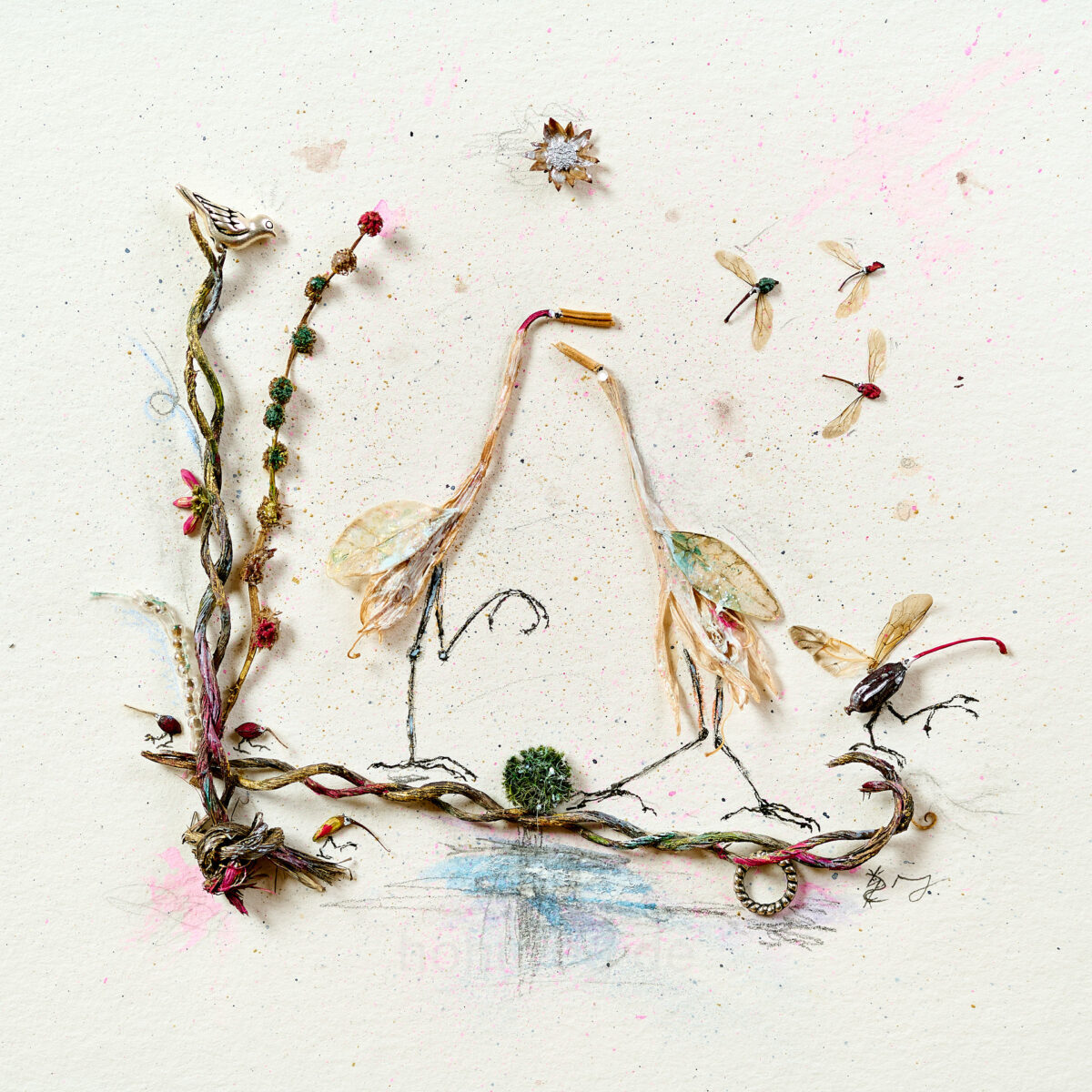
I don’t yet want to decide on a final title for these little creatures made of flower remnants, embedded in a landscape of woven, found grasses. The framing is also still open. More to follow – I promise.
The collage presented here is the start of a new series. Two more scenes will complete the series – with further unexpected discoveries in places and times that don’t really promise anything special.
But I’ll tell you more about that in the next newsletter.
And because the smallest details just won’t let me go, this article ends with one last detail: the Barbary wagtail.
The journey of the collage series continues – be part of the newsletter.
If you want to find out more about the inspirations of this journey right away, you can read on here – from frustration on gray days to new ideas for the dark season.
With best wishes
Magdalena

Leave a Reply