
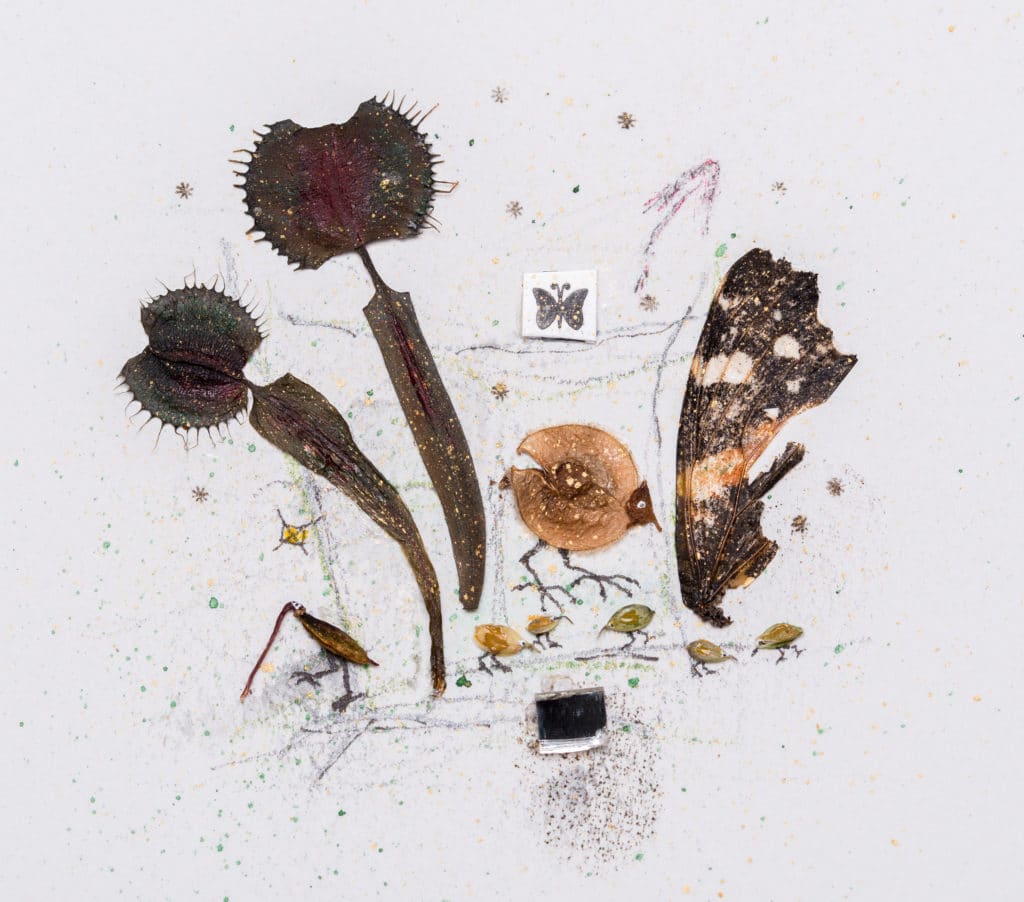
The quail is an inconspicuous bird that lives in secret and is no longer as common in our regions as it used to be. The quail hen has up to twelve chicks. In the picture I only count five chicks. Oh dear! Where is the rest of the flock?
I don’t want to tell any sad stories here!
So let’s move on to a sober list of materials:
Favorite paper!
- As for many of my collages, I used a lightly textured handmade watercolor paper that is produced in France. It has such a wonderfully warm white color and feels very pleasant, a little sandy to the touch. The paper is extremely durable and does not yellow. I have drawn with watercolor, with fine drawing pens, pencils and colored pencils. For the small drawings, I set great store by using a fine-line pen with lightfast pigments in the finest line width! The entire collage measures approx. 6 x 7 cm.
Viewed in detail from left to right:
Stinks like soap!
- At the bottom left an unripe seed capsule of balsam. In this collage, it has become a little snipe. Self-confident and determined, she struts out of the picture. The balsam grows like crazy everywhere here and I can pick what little I want to use without hesitation. You may be familiar with the small pink flowers of this herb, which grows along the edges of forests and streams and exudes a somewhat unpleasant soapy smell in some weather. When the seed capsules are ripe, they burst open when touched. I only take the small unripe ones anyway. And when dried, the seed capsules naturally don’t smell at all.
The Venus trap is a carnivorous plant. It does not eat quails!
- The snipe is hiding under two wilted leaves of the Venus trap, which grows in a flower pot on my windowsill. After the leaves die, I harvest and press the small leaves. But only the really small ones.
I’m not interested in every piece of garbage!
- Top right next to the Venus trap: Cut-off piece of a blood sugar test strip, which can be found on all paths. In the distant future, archaeologists will probably be able to deduce the number of diseased inhabitants in the corresponding age from the number of test strips found in the soil layer examined. Future researchers will certainly postulate that the percentage of diabetics in the population around 2017 was particularly high in the Boberg dunes in Hamburg. These plastic strips are durable. Weeks later, I am still strolling past the same plastic pieces in the same places. I only like the blood glucose test strips with the butterfly pictogram. On other test strips there is nothing at all or just the boring logo of the manufacturer. I find them boring. I’m far from interested in all the garbage.
It flutters, the elm tree!
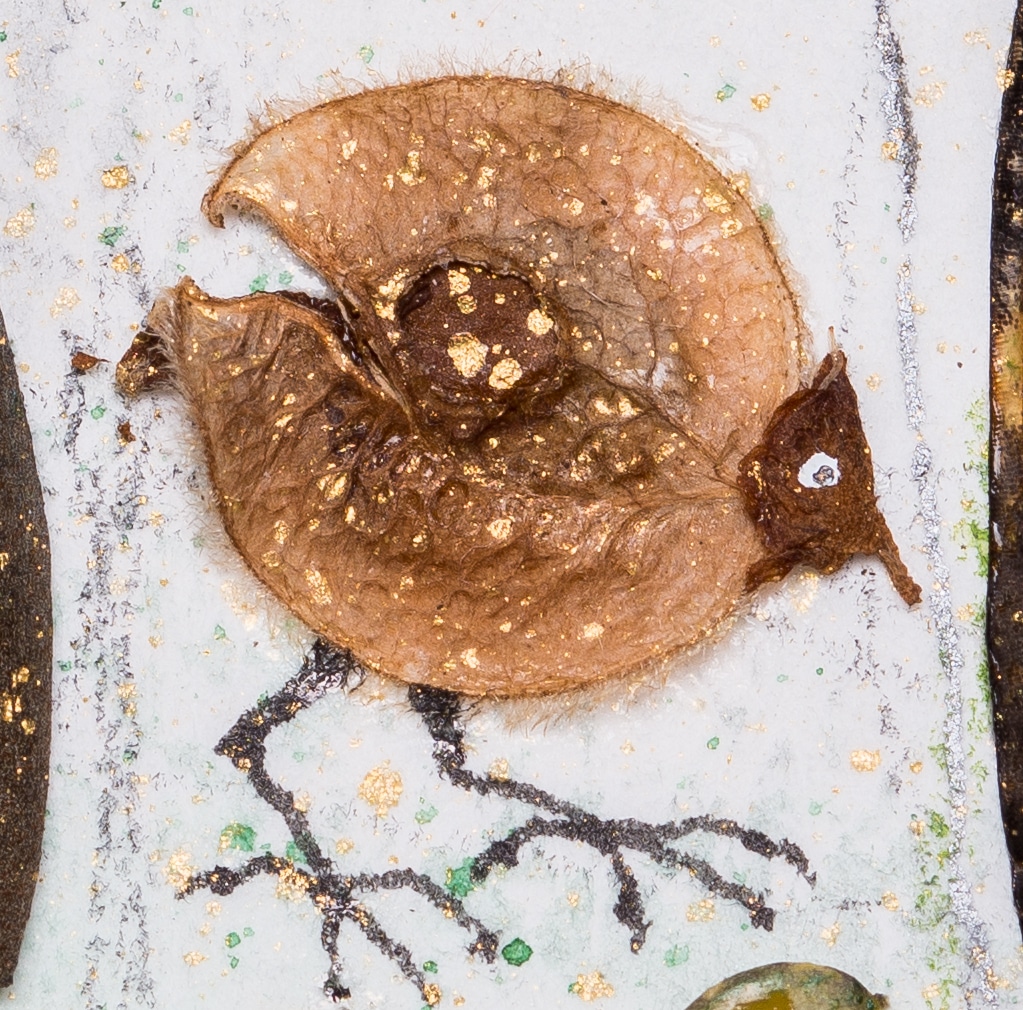
- Beneath the butterfly is the nut fruit of a fluttering elm, which embodies the central figure in this work as a quail hen. It could also be a kiwi. This is the case in some pictures. Some of these seeds are surrounded by fine silvery cilia. This makes them really look like kiwis. This little nut here reminds me more of a quail.
Chicks of small stature?
- At their feet are five seed pods – I mean, of course – where the chicks scurry. These very small plant parts come from a short-mown summer meadow.
Total sell-out!
- At the bottom of the picture, as a side note, the mirror fragment of a small disco ball. You know – those polystyrene balls covered with mirror squares. Years ago, I found a somewhat worn example on one of my walks. Some of the mirrors were already missing. I scraped off the rest and still use this stock today. Slowly, however, the supply is actually running out. These mirrors can be found in many of the collages I have created over the years. So it’s best to grab them NOW! The collages with the mirrors will soon be completely sold out!
Downfall of an admiral
- The pitiful remains of a butterfly lead out of the picture on the right. The Admiral sank on the high seas. I was only able to salvage this small remnant from the Baltic Sea, where it was drifting on shallow waves off Scharbeutz. It was a windless day in September and I really enjoyed the late summer beach and bathing day. At home, I have an extensive collection of butterflies waiting to be processed. For this picture, however, it had to be this one. Inconspicuous and frayed. It has been washed out of my hands a few times. Several color pigments have been washed away, some small areas are already completely translucent. But a delicate and at the same time impressively tough skeleton runs through the wing remnant and holds it together. On rocking waves. Shortly before sinking, it found its destiny – here it is now.

Leave a Reply