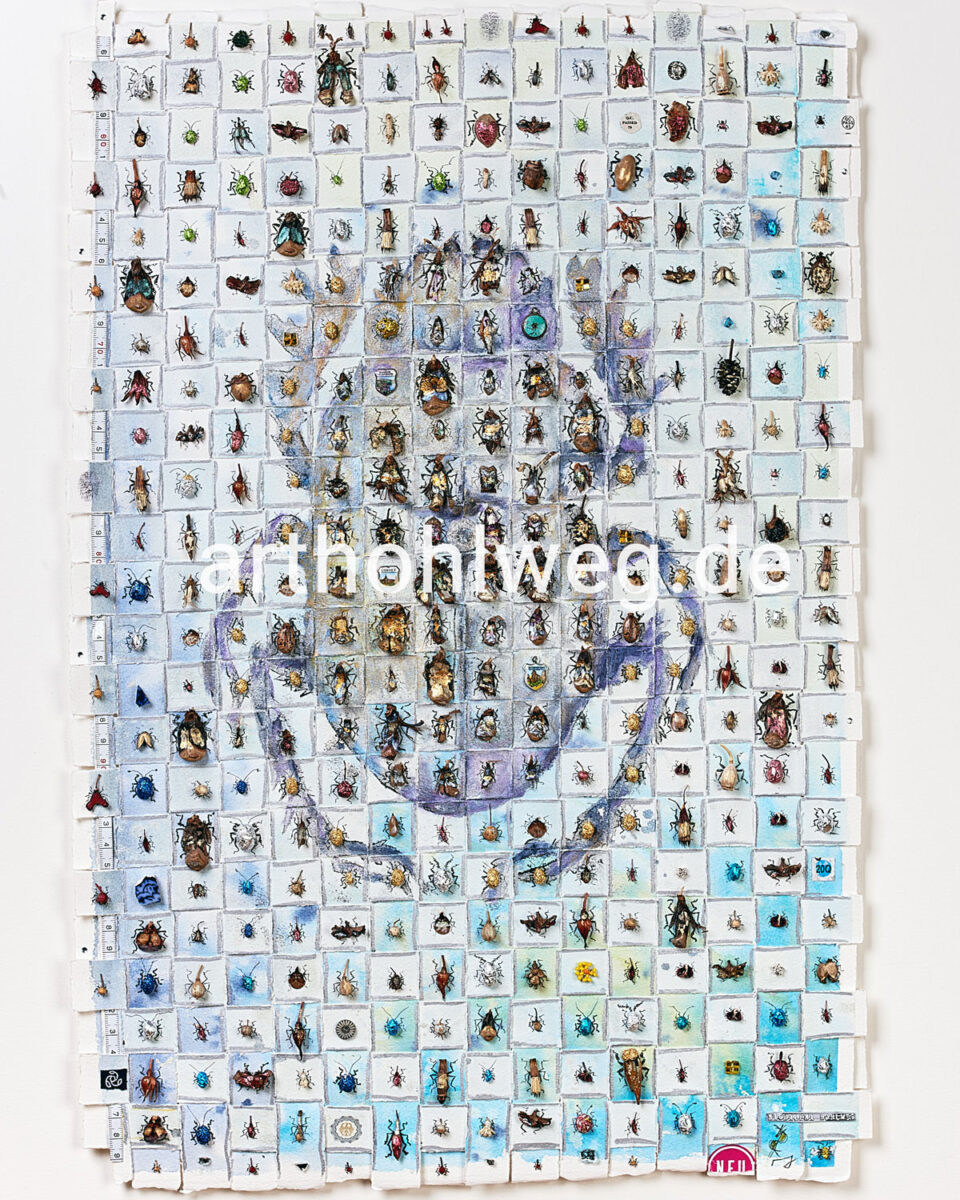
Here I answer the most frequently asked questions about my work
1. how did your idea to create these unconventional works come about?
I find it difficult to give a concise answer. How much time do you have?
I’ll try it anyway – starting with the shortest possible version:
One of my favorite sources of inspiration is to walk through the world as if I had never seen it before. I go outside my front door and resolve to set aside any judgment, any knowledge about my surroundings. It’s not easy – but it’s worth the effort.
Try it out for yourself if you are looking for new ideas. You might find that it’s already difficult not to judge the weather. It gets even more exciting when I pretend I’ve never seen a tree before. Or a house. Or a leaf.
Please tell me how you feel about it – I can barely last ten minutes myself. But this short experiment alone opens up a surprising amount of space for new perspectives.
The more detailed answer:
Every new development needs a learning phase and lots of experimentation – whether it’s about art, technology or science. For a long time, I explored different artistic techniques and materials. But in order to develop something truly original, at some point I had to break away from role models and learned paradigms.
I took the risk of treading unknown paths and freeing myself as much as possible from fixed ideas.
When I was still searching for my own artistic point of view in the 1990s, I often encountered the assertion that the development of art was basically linear. What was meant was that everything had already been researched, depicted and said – especially realism. At the beginning of the 2000s, it was considered in many places to have been completely “worked through”.
The human nude in particular was treated as exhaustive. And indeed, the sheer number of female nudes in art history is almost impossible to keep track of. So why add more?
There are good reasons for this. One of them is that most of these nudes were created by men – and show women as passive objects.
A personal example:
I visited the Christian Daniel Rauch Museum in Bad Arolsen. The classicist sculptures are displayed in a light-flooded room as if in an open depot. White figures, heroic gestures, noble postures – the room is filled with godlike grandeur. I felt surrounded by imposing personalities with radiant faces and powerful bodies.
(Only Goethe is said not to have been entirely happy with his monument. Under the marble housecoat, his belly bulges rather… humanly. But perhaps that was already radical realism).
Among all these heroes, however, there is one figure that clearly stands out:
the tomb of Queen Louise of Prussia.
She is the only person lying down in the room. She radiates calm, beauty and perfect purity. The powerful poses are reserved for the many male figures – in art as in real life. Women are underrepresented. And when they do appear, it is often in passive roles.
For a long time, I therefore believed that my own point of view was not worthy of being portrayed and shown.
Today I know that it was precisely these doubts that helped me to find my own visual language – and to develop my own new forms of expression.
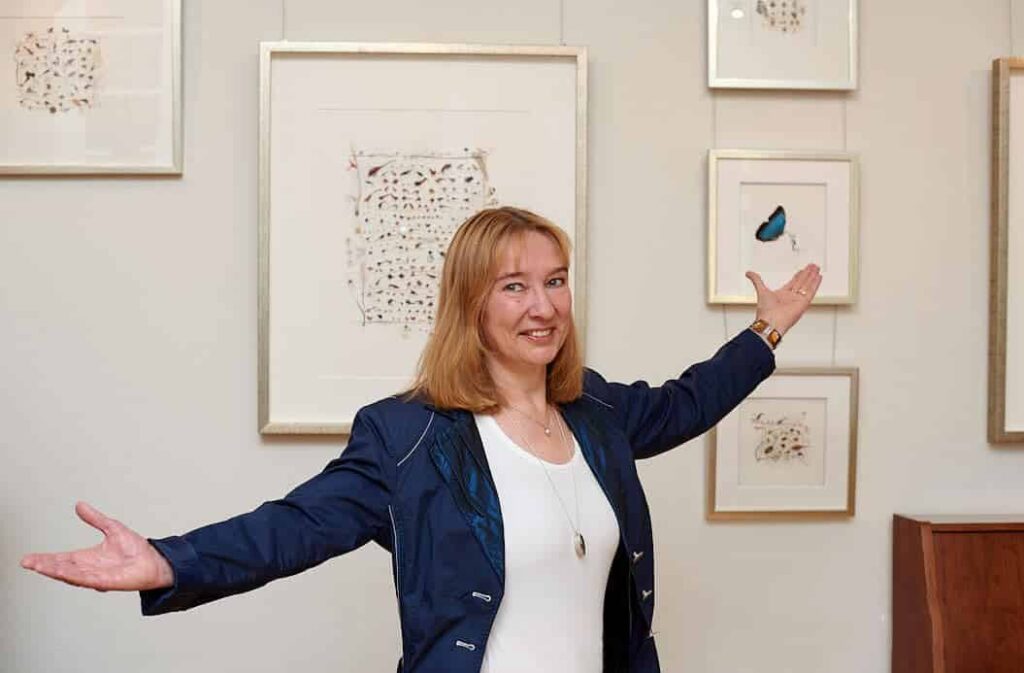
2. what is the lifespan of the collages made from found objects?
My earliest works with found plant material are now almost twenty years old. During this time I have made an interesting observation: some of the colored pencils I used at the beginning have faded much more than some of the plant materials themselves. Plant paints are amazingly robust – who would have thought it?
For many years, I have therefore worked exclusively with fine artists’ pens that contain real pigment colors. I dab the found objects in places with high-quality, lightfast watercolors in order to set specific accents. Incidentally, these colors also give some tiny, fragile elements a little extra stability – a kind of gentle support without taking away their independence.
However, many of the materials used do not require any treatment at all.
Like most artistic works, my exhibits should not be exposed to direct sunlight for long periods of time. Should a repair to the work or the frame nevertheless become necessary, this can usually be rectified easily. Ideally – and preferably – I do this myself.
3. the framing
…always require a spacer strip so that the work does not come into direct contact with the glass and is not damaged or deformed in the long term. For this reason, many commercially available standard frames are not suitable.
Professional framing requires experience in dealing with delicate, sometimes three-dimensional materials. I have acquired this experience over many years – also through my own failed attempts.
To ensure the long-term stability and durability of my works, they only leave my studio fully framed.
4 The advantage of low-reflective glazing
Standard glazing is not enough to make the very fine details of my collages truly visible. Reflections and light reflexes quickly obscure what it is actually about.
However, I can show the difference between normal glass and low-reflective museum glass better than I can explain it. In the following picture you can see a collage behind standard glass.
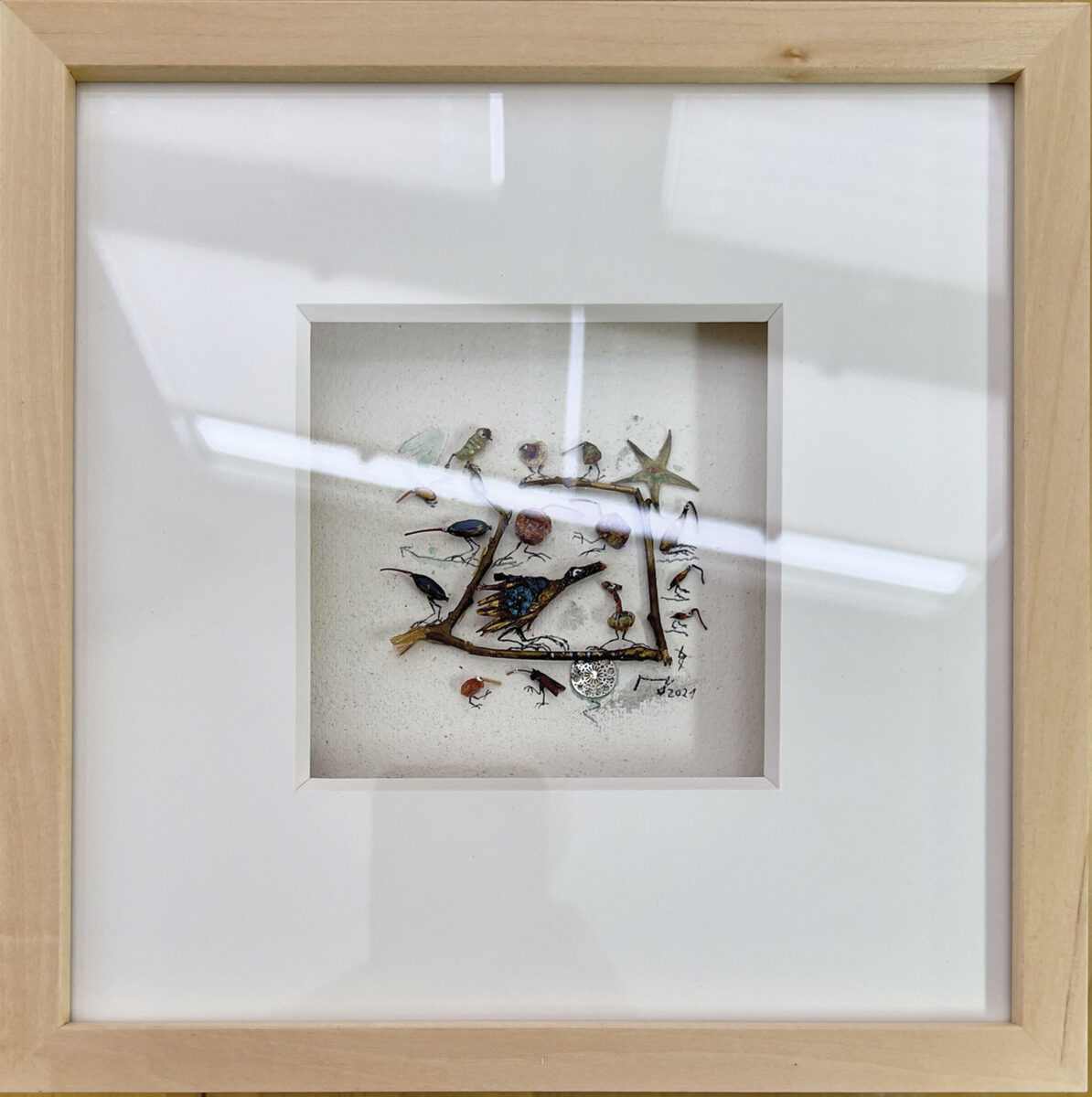
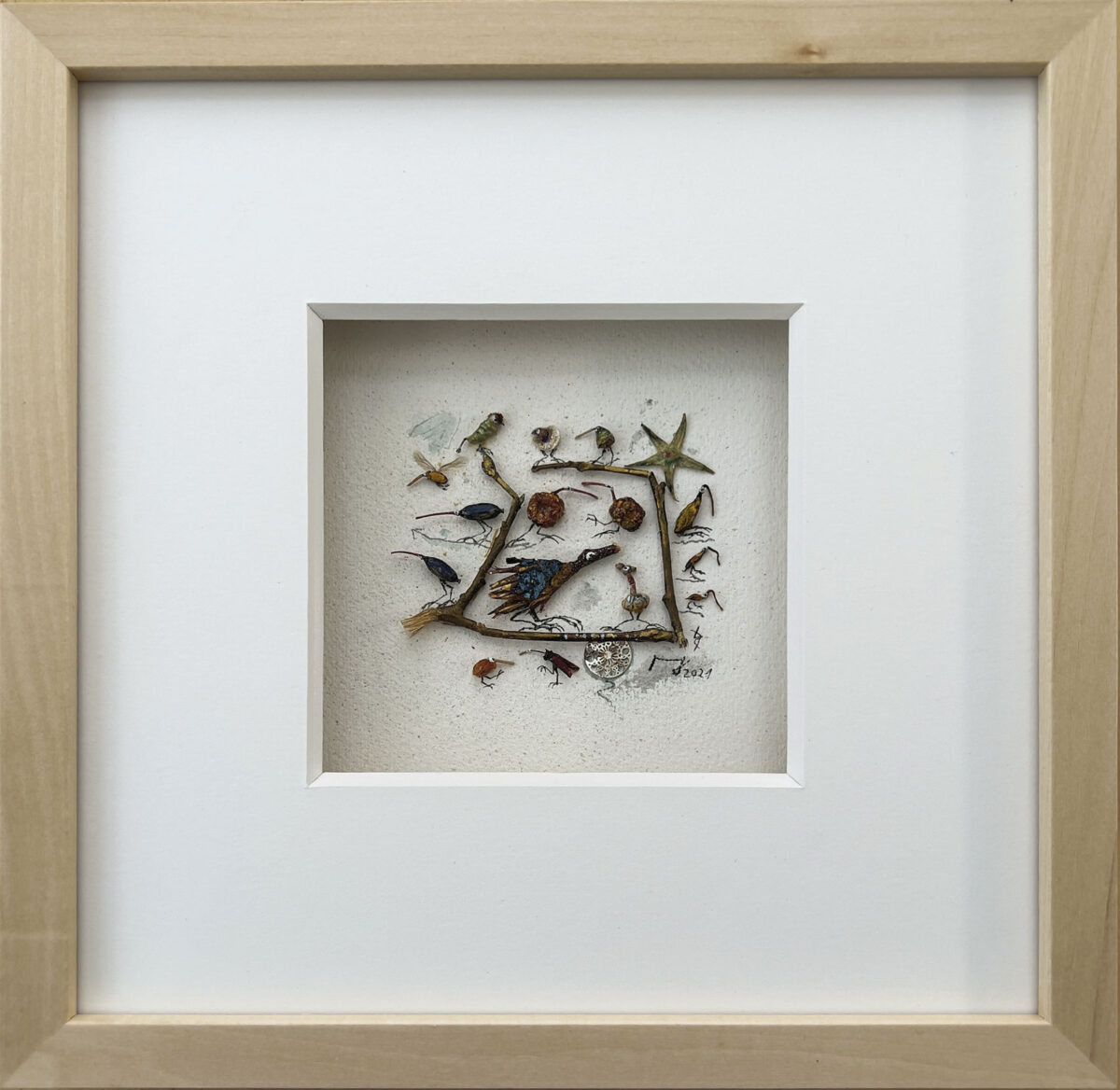
The next picture shows the same collage behind the low-reflection glass that I use for my work. At the same time, this glass offers UV protection for greater light resistance.
The following applies to my collages made from the smallest trifles: Only the best for the leftovers
5. are the finds preserved?
For particularly fragile finds, I allow the glue to soak in slightly – this has the effect of gentle preservation. Another important point is the dust-proof framing: the finished exhibits are completely sealed behind the glass.
6. is a special adhesive used?
A standard, acid-free paper glue is used. If you notice that there are hardly any traces of it in my work, this is due to the careful way I work – precision is simply a matter of practice.

7 How long does it take to complete such a work?
That’s not an easy question either. I often work on several independent scenes – a work is rarely created in a single process. As soon as I discover a suitable found object in my collection, I add it to works in progress. I move some elements back and forth several times until I am convinced of their effect and finally fix them.
Of course, collecting the finds themselves also takes time. However, I never specifically go looking for new materials. Instead, I’m constantly discovering little things in passing that I pick up – in my jacket pocket, in my wallet or in some small container. Pieces larger than about one square centimeter rarely interest me.
In a nutshell, depending on the complexity and the items I find, I estimate that it takes me between three hours and three years to complete a piece – depending on how patient I am with my little discoveries.
8. where can I purchase your works?
A small selection you can see here. I will be happy to send you your personal original directly from my studio. Please send inquiries by e-mail to galerie@arthohlweg.com
9. do you also design the collages from found objects on request?
On request and depending on the individual case, I will be happy to check whether your wishes can be combined with my collection and my own ideas.
Subscribe to my personal newsletterto stay informed about new work and developments.