
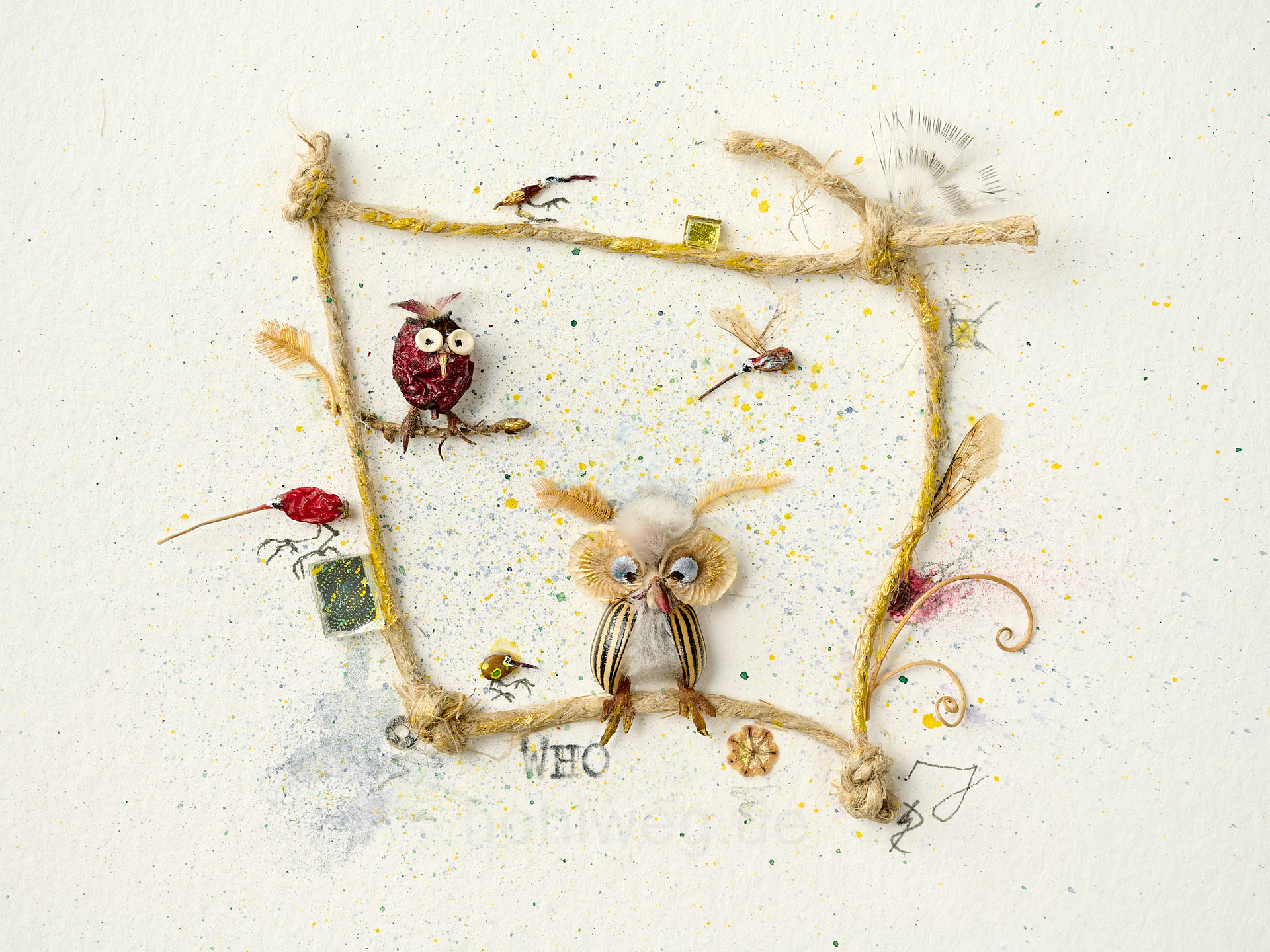
A series about bird feathers and their stories
Many of my works show bird-like creatures – creatures that do not exist in reality and yet demand their place somewhere between memory, observation and fantasy.
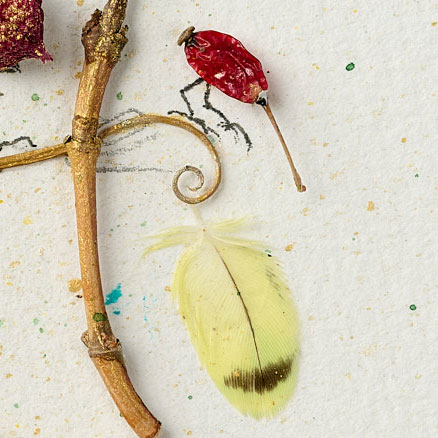
And yet the thought always creeps up on me that I am still a long way from the actual diversity of bird species on our planet. Nature itself remains the unrivaled master of variation. So my work – like the migration of birds – is far from complete, but rather an ongoing journey.
This is how other bird creatures are created, each embedded in a tiny habitat that also unfolds in almost inexhaustible forms.
In order to pay homage to their natural models and the entire impressive world of birds, I have dedicated a separate series to these new works:
Each work in this series will feature a bird feather.
The provisional title of this series of works is: Federzeichen.
Of signs, springs and connections
The title is close, almost as if it had found itself. So maybe it will stay with the feather signs.
For is it not precisely such signs that accompany us?
I fondly remember the unmistakable call of the kibitz, which I long considered a reliable harbinger of spring – a living calendar until the kibitz disappeared and before we started reading our seasons from apps.
Or the harsh, piercing call of migrating wild geese flying high above us, awakening a longing that is hard to grasp – somewhere between wanderlust and an indefinable inner tug.
Each bird species seems to have its own unique way of reminding us of something that we can rediscover again and again: the subtle, barely tangible secrets of life.
A prelude with an owl – and other ingredients
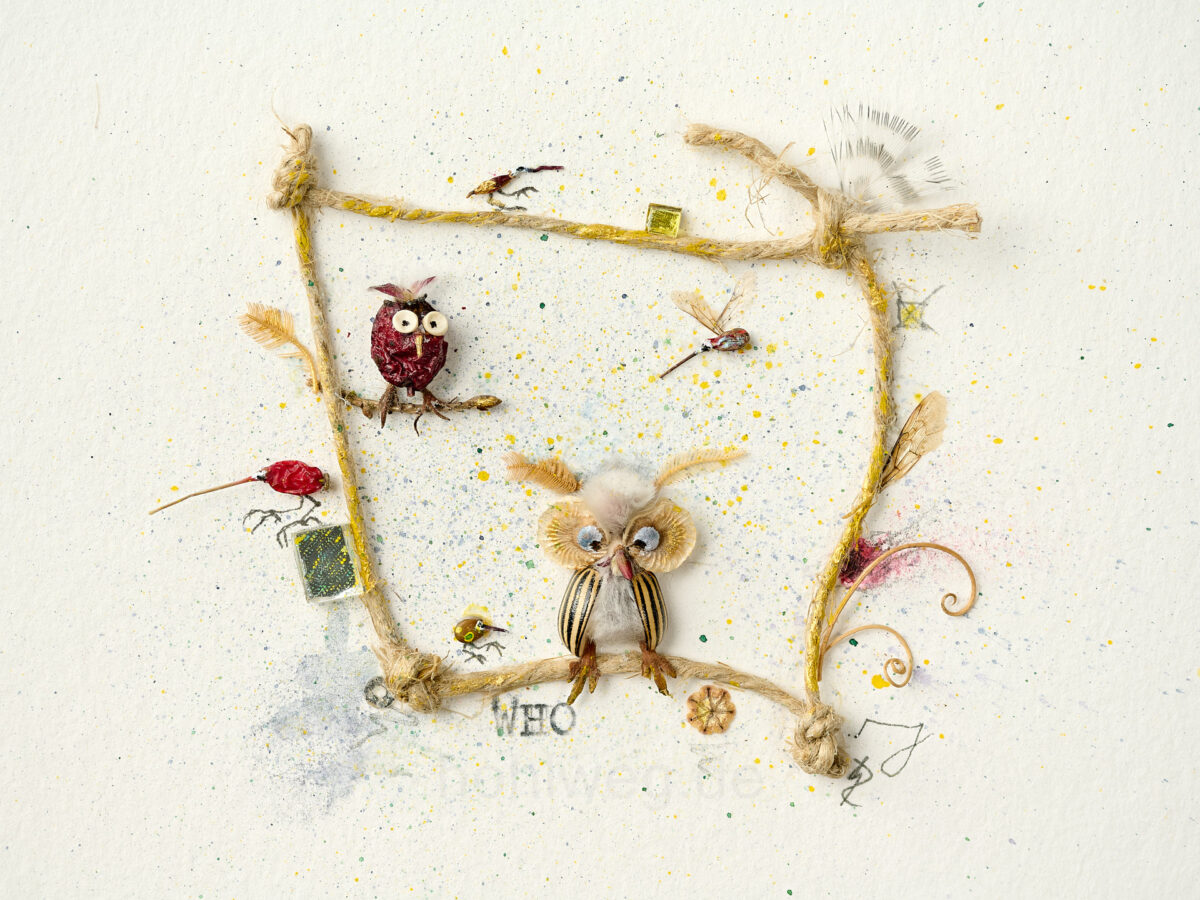
I dedicate the first work in the Feather Signs series to the owl.
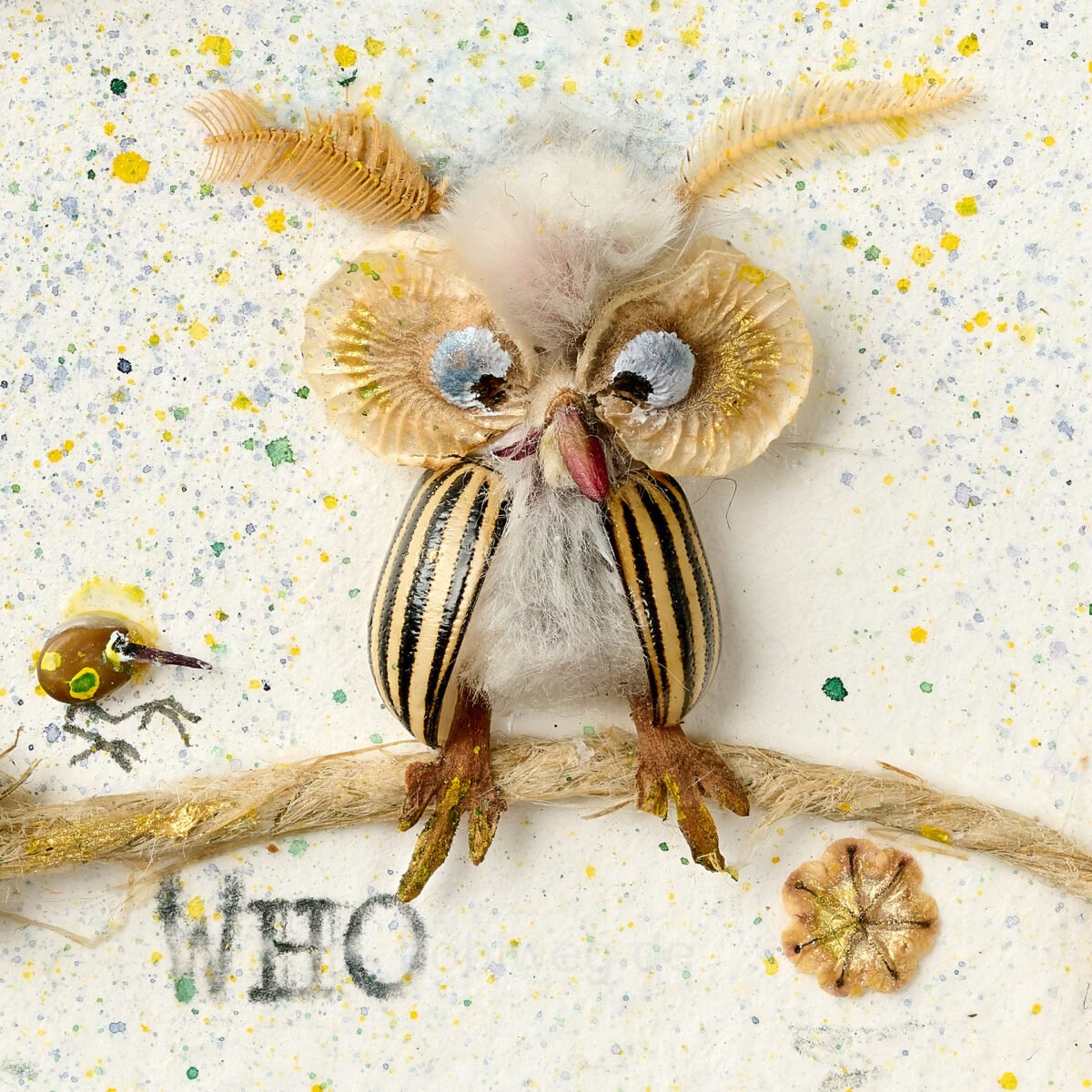
Trying to explain its magic would probably be like carrying owls to Athens – because it defies explanation anyway. We all feel it in our very own way.
In fairy tales and myths, the owl has always been attributed with a deep, almost uncanny knowledge. It can see where we are groping in the dark, and its nocturnal “Whouuhuu” often carries a touch of goose bumps with it.
My owls, however, are less awe-inspiring. And yet – as if they knew something – or not.
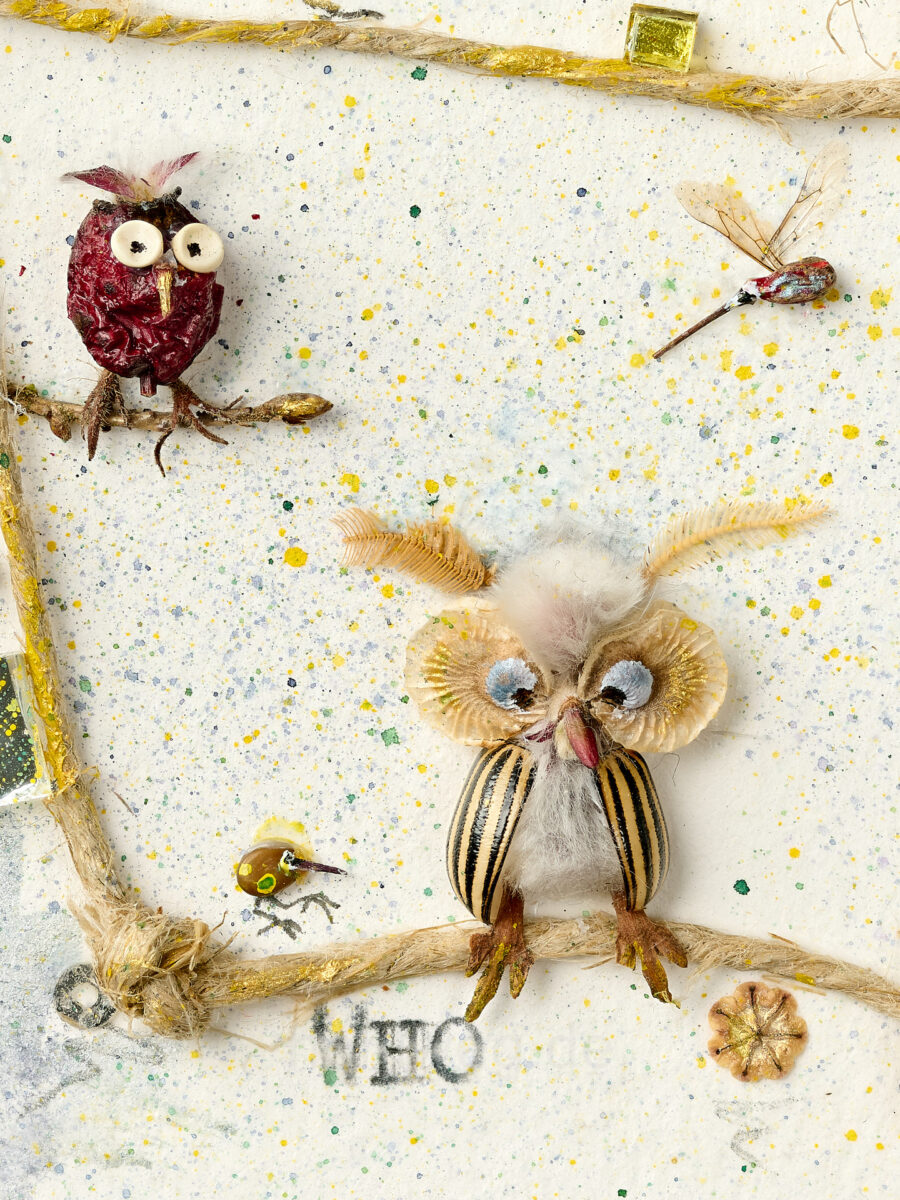
In keeping with this, a tiny mirror tile is concealed in the work.
If you look closely, you will discover it on the far left of the picture. (The entire work can be found below).
An owl feather is of course also part of the scene, albeit in the most modest size imaginable. As a side note, it sits at the top right – reserved and yet of central importance (it can be seen in the picture below)
And the owls themselves? Well, it’s worth going a little further afield for them.
A “Who’s Who” of materials
The list of materials used reads like a very personal “Who’s Who” of my art world – a collection of things that may seem inconspicuous on their own, but together develop a life of their own.
The order is less a hierarchy than the given confusion in my collection:
Butterfly eggs, willow catkins, wing covers of potato beetles, a rowan berry, fragments of the seed head of the colchicum, parcel string, antennae of a moon butterfly, hollyhock seeds, insect wings, the lid of a poppy seed capsule and the fine bracts of birch seeds. Incidentally, the butterfly eggs here serve as the eyes of the smaller owl, i.e. the one with the rowan berry body. “Eyes like fried eggs” – in a way.
By the way, the butterfly eggs and antennae of moon butterflies come from my breeding program. Click here for my experiences with the metamorphosis
I mean, that should have been it.
Or have I forgotten something?
Yes – the title of this first work should of course not go unmentioned:
Eulenspiegel
And as soon as you have settled into the shadow of the owl, a budgerigar flutters into the picture – a transition that defies any solemn dramaturgy.
Even among bird species, I am reluctant to put meaning and importance in a fixed order.
The fluttering nature of these adorable parakeets fills thousands and thousands of human households with little moments of happiness – a quiet chirp here, a wry glance there, and everyday life seems a little easier.
That’s the magic of parakeets: they open hearts.
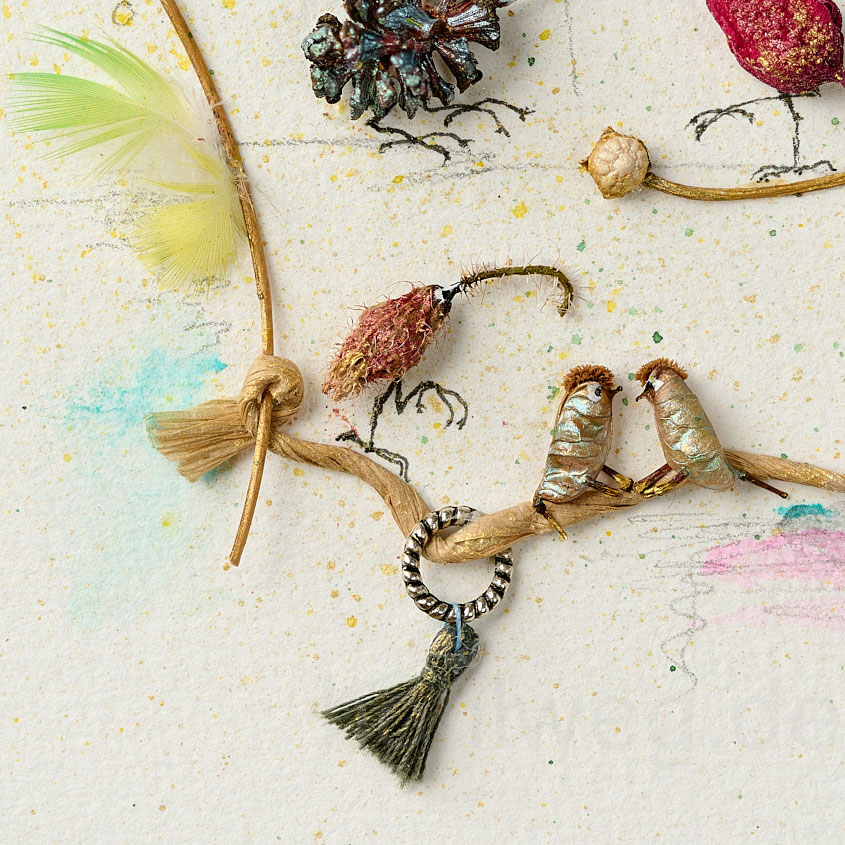
Whether the parakeets themselves are always of the same opinion is left open at this point.
However, in order to properly honor these little housemates, I have also dedicated a separate piece to them. May it be a reminder that they are by no means decorative accessories, but complex, sophisticated creatures with astonishingly great needs – regardless of their comparatively modest acquisition costs.
Small feathers can also be found in this work. As they come from a large aviary, they could be from either a budgerigar or a cockatiel.
But does that really matter in the end?
They are always a source of joy.
And so this work from the Federzeichen series bears its name as a matter of course:
Spring parakeets
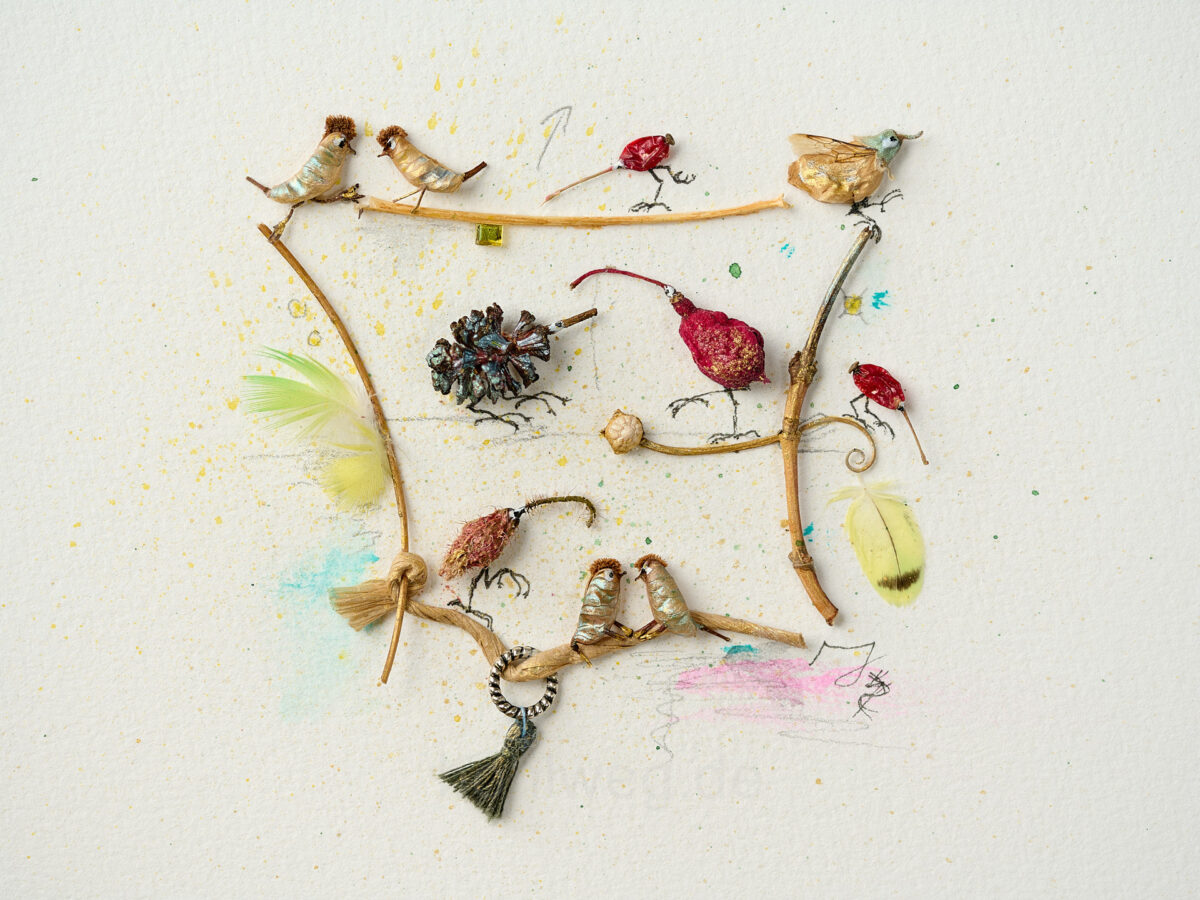
The appearance of the parakeets is also diverse. Different species come together here, which – at least in these few square centimetres – live in perfect harmony in an almost exemplary habitat.
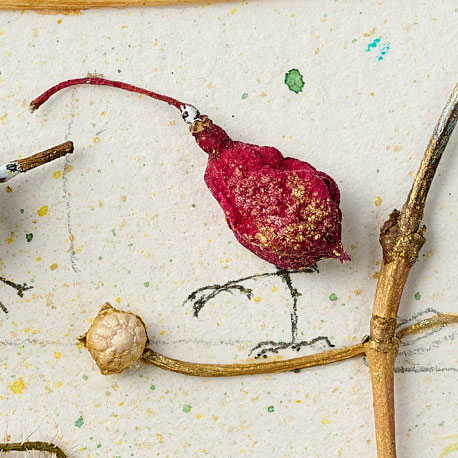
A feathered gardener with memory lapses
Let us now return to another native bird species that is the subject of many a story: the jay.
It is known to owe its name to its fondness for acorns, which it collects in the fall with admirable devotion, hides – and to a not inconsiderable extent, forgets again.
A fact that incidentally makes it one of the most industrious gardeners in our forests. What the jay loses, the forest gains.
Between reputation and retreat
With his piercing call, he often announces our arrival long before we even get to see him.
For as communicative as he is acoustically, he is just as reserved in direct contact. Distance is his preferred form of politeness.
And yet it occasionally gives itself away – with a flash in the branches:
These almost unreal glowing, turquoise-blue feathers look as if someone had hung a piece of sky between the branches.
Finding a nib like this is a rare stroke of luck.
A rarity that also lends this work its very own brilliance.
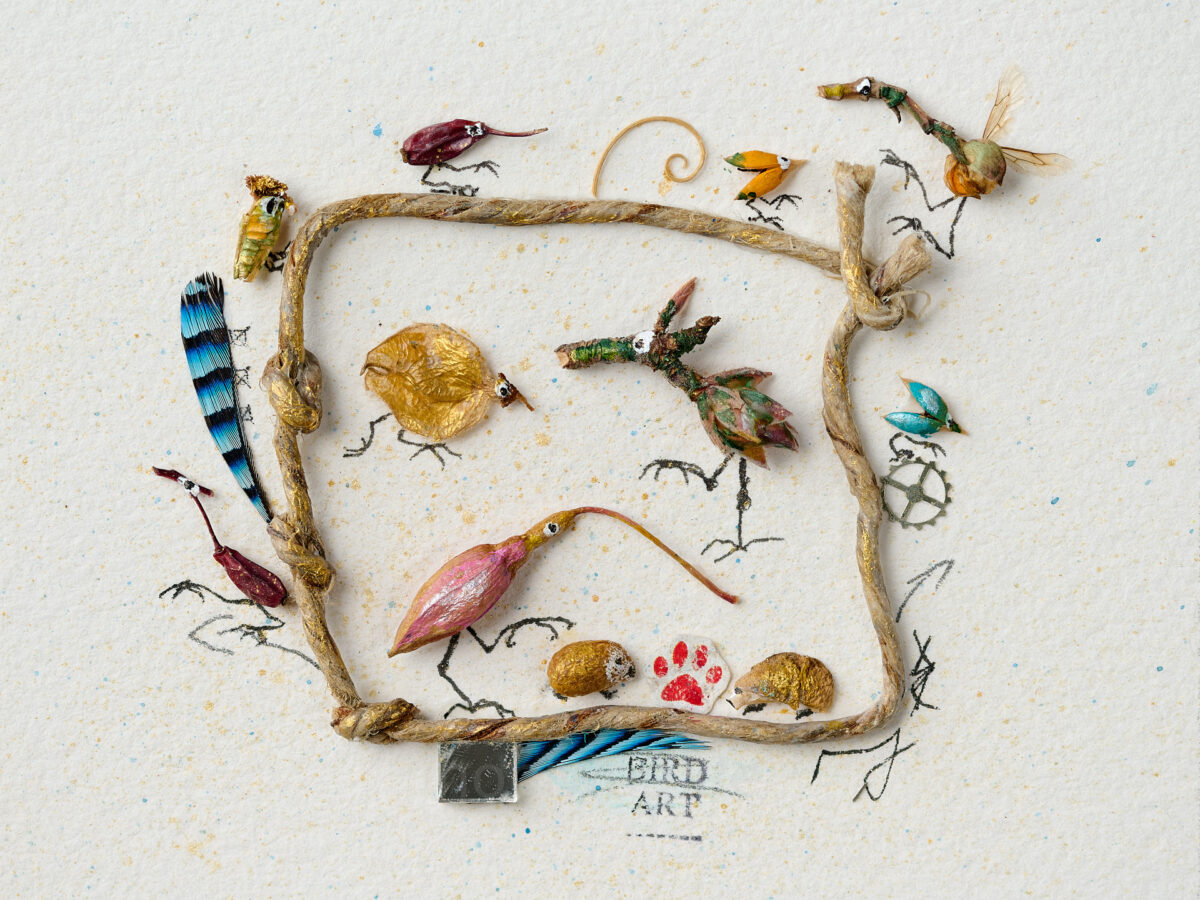
A scene with tension
As the jay is an inhabitant of our meadows and forests, it is not alone in this work.
Two hedgehogs have arrived – and look as if they are in the middle of a discovery.
They seem to be following the impressive trail of a cat with visible seriousness.
Whether they actually want to meet her remains an open question.
Incidentally, the two owe their appearance to the seed capsules of the peacock coneflower – a combination that fits in surprisingly well with their slightly prickly personality, in my opinion.
An ensemble of found objects
Here, too, an idiosyncratic company of materials comes together – each with its own story, each with an important contribution to the big picture:
A fluttering elm seed, barberry fruit, insect wings, a fuchsia flower, a leaf bud, parcel string, a cogwheel, a mirror fragment as well as fineliner and watercolor.
As is so often the case, something emerges from this mixture that is difficult to translate back into its individual parts – the materials have agreed on their common narrative.
The title: Between heaven and earth
Because the turquoise glows like a piece of sky that has settled in the branches around the hedgehogs – my favorite so far, even if it doesn’t quite want to be held on to yet.
These first works in my new series of pen and ink drawings are still waiting to be framed – they need to be chosen carefully and finished with care.
Framed works from my studio can be found here Handpicked
Availability as well as all dates and measurements can be found in the workroom after registration. Click here to register directly

Leave a Reply